
The XJ750 workover rig specifications published by Hubei Link Petroleum Equipment describe a twin-engine truck-mounted workover rig. The website lists its workover depth as 6,500 m with 3-1/2 in drill pipe and its maximum hook load as 1,800 kN, with a 38 m mast on a dedicated seven-axle 14×8 carrier. Suitability for a specific well depends on the confirmed well program and string design.
This guide is written for procurement managers, tender engineers and rig superintendents. It explains what each published figure means, which condition travels with it, how to judge fit against your own job, and what to ask for in a project-specific proposal. For the product listing and inquiry form, see the XJ750 workover rig product page.
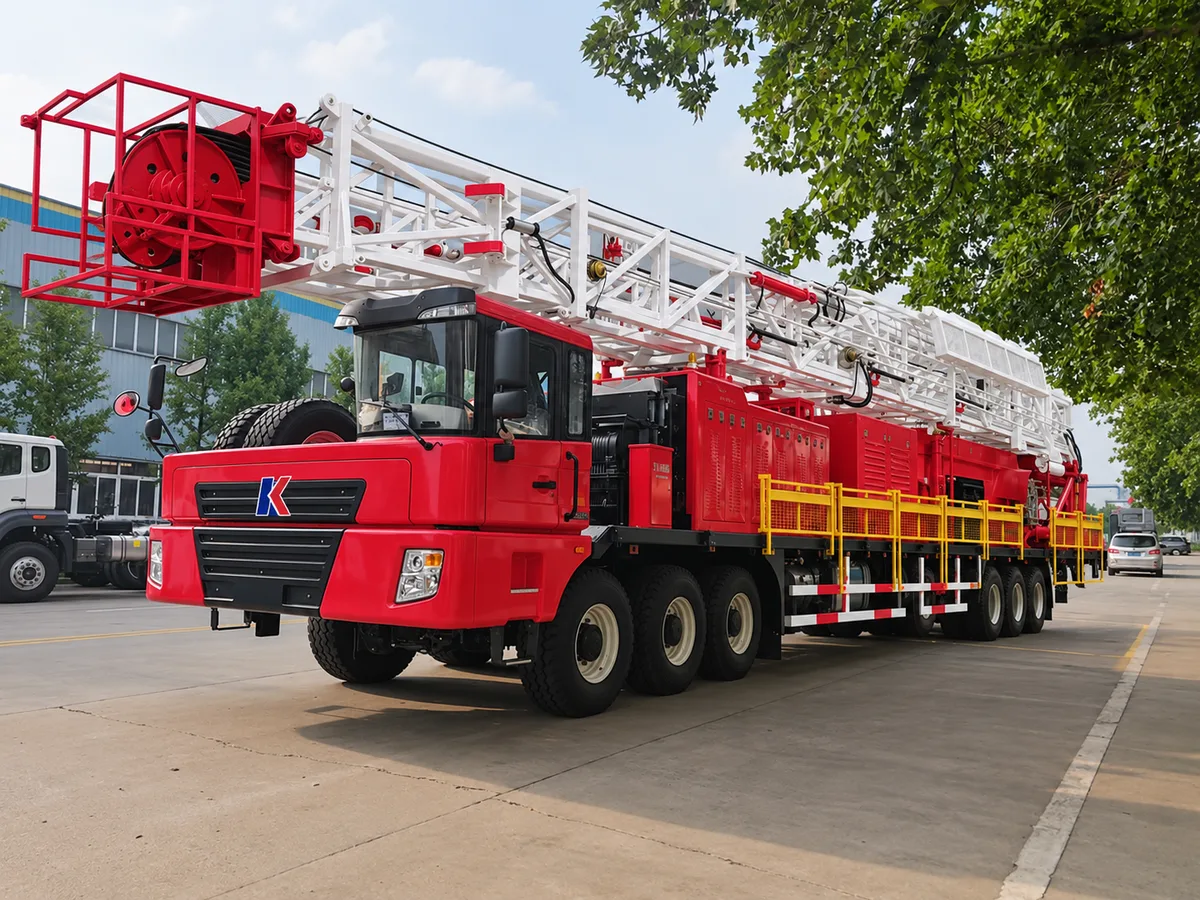
What are the core XJ750 workover rig specifications?
| Item | Published value | Basis / condition |
|---|---|---|
| Workover depth | 6,500 m with 3-1/2 in drill pipe | Subject to well program and string design |
| Maximum hook load | 1,800 kN | Maximum value; rated hook load not published on the reviewed page |
| Engines | Twin 540 hp or twin 550 hp | Listed alternatives in the complete-rig table; exact package confirmed per project |
| Drawworks | 750 hp | Stated separately from engine power; not additive |
| Mast height | 38 m | Complete-rig table |
| Carrier | Dedicated seven-axle 14×8 | Published configuration |
| Minimum turning diameter | 38.6 m | Complete-rig basis; may differ by tire/option |
| Minimum ground clearance | 340 mm | Complete-rig basis; may differ by tire/option |
| Transport dimensions (L × W × H) | 22.6 × 3.3 × 4.64 m | Published dimensions; do not establish legal road transport |
Read the table as a set of documented ratings, each with its own basis. None of the rows by itself says whether the rig suits a particular well; that judgement needs your well program, tubular schedule and site conditions.
How do you match the XJ750 to an application and duty?
Selection starts from the job, not from the headline numbers. Before comparing rigs, define:
- Job type: completion, recompletion, tubing or rod replacement, fishing, sidetrack preparation or plug-and-abandon work.
- String design: tubular type (drill pipe or EUE tubing), size, weight and grade, and the deepest string you expect to run or pull.
- Expected loads: string weight in the fluid you will use, plus allowances for drag, stuck-pipe pulls and fishing jars, as calculated by your drilling or well engineer.
- Mobility pattern: how often the rig moves, over what roads, and how much rig-up space each wellsite offers.
- Environment and rules: climate, emissions requirements and local transport regulations.
Once these are written down, each XJ750 specification becomes a check against a requirement rather than a sales figure. A job that sits well inside the published depth basis and maximum hook load, with routes the carrier can travel, is a candidate for a detailed proposal; a job near any boundary needs the supplier’s project-specific load and configuration data before a decision.
### Buyer decision table
| Buyer question | What to check | Evidence to request |
|---|---|---|
| Does the depth basis match my string? | Your tubular type and size against 6,500 m with 3-1/2 in drill pipe | String design calculation; supplier’s statement for your tubular |
| Is there enough hoisting capacity? | Your calculated peak load against the 1,800 kN maximum hook load | Rated hook load, mast static load and load chart for the quoted configuration |
| Which engine package is quoted? | Twin 540 hp or twin 550 hp, and the matching transmission | Powertrain datasheet for the exact assembled package |
| Can the rig reach the wellsite? | Route, axle loads, permits, turning space | Transport mass and axle-load statement for the quoted configuration |
| Does the mast suit my stands? | Stand length and racking needs against the 38 m mast | Racking/setback capacity with its tubular basis |
What does the 6,500 m with 3-1/2 in drill pipe depth figure mean for a buyer?
The website lists XJ750 workover depth as 6,500 m with 3-1/2 in drill pipe. XJ550 nominal workover depth uses 2-7/8 in EUE tubing, while the XJ650 nominal servicing-depth figure uses 2-7/8 in EUE tubing and its separate nominal workover-depth figure uses drill pipe. These headline figures are not a like-for-like capacity ranking. Suitability depends on the confirmed well program and string design.
### How to read a drill-pipe depth basis versus an EUE tubing depth basis
A depth rating is really a statement about string weight: how long a string of a specified tubular the rig can handle under the supplier’s stated conditions. Drill pipe and EUE tubing differ in weight per length and in connection type, so the same rig would show a different depth figure for each. That is why a figure stated with drill pipe cannot be compared directly with a figure stated with EUE tubing on another model.
To use the XJ750 figure for your project:
- Identify the tubular you will actually run, including size, weight and grade.
- Ask your well engineer to calculate the string load for your deepest planned run, in the fluid you will use.
- Compare that load with the rig’s load ratings, not just with the depth number.
- Ask the supplier to state the depth or load basis for your specific tubular in the proposal.
For background on tubing-based figures, see XJ650 workover depth and EUE tubing and XJ550 workover rig specifications explained.
How should the 1,800 kN maximum hook load be read?
The reviewed XJ750 page lists a maximum hook load of 1,800 kN. It does not publish separate rated hook load, mast static load or setback/racking capacity. Request these in the project-specific technical proposal.
### Maximum hook load versus safety margin
A maximum hook load is the ceiling of the hoisting system under the supplier’s stated conditions. It is not the load you plan routine operations around. In practice, engineers plan the job against a working load, keep a margin between that working load and the rig’s ratings, and treat stuck-pipe pulls and jarring as separate load cases that must also stay inside the ratings.
How much margin is appropriate is a project decision. It depends on your company’s standards, the condition of the string, the well’s risk of sticking and the operator’s procedures. This article does not suggest a margin value, and none should be inferred from the maximum figure alone.
Three ratings are often confused:
- Maximum hook load: the published hoisting ceiling, here 1,800 kN.
- Rated hook load: the load the supplier states for normal operation with a defined line arrangement; it must be confirmed per project.
- Mast static load: the structural rating of the mast; it must also be confirmed per project, together with setback/racking capacity.
Ask for all three, with the load chart for the quoted configuration. More background is in Workover rig hook load explained.
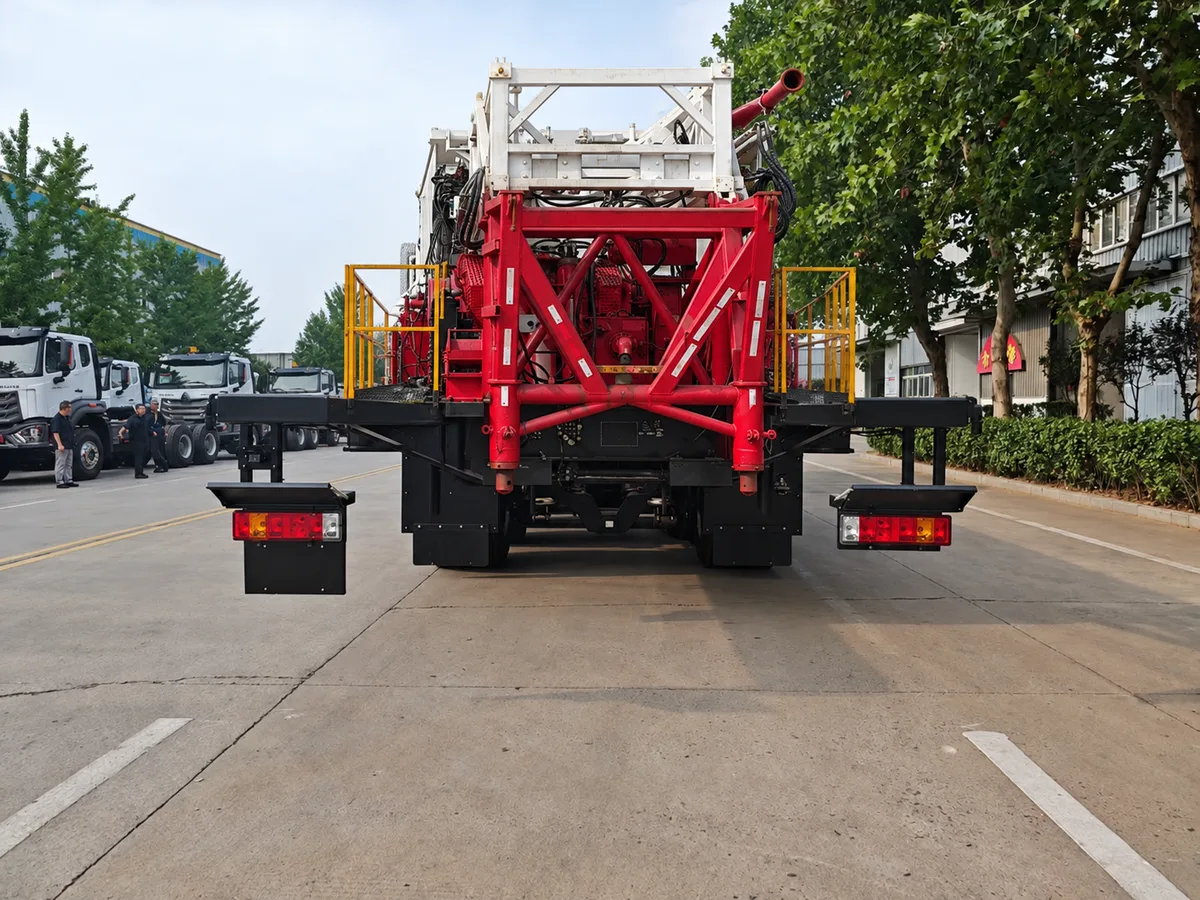
What does the twin-engine powertrain consist of?
The XJ750 complete-rig table lists twin 540 hp engines or twin 550 hp engines. The exact engine and transmission package requires engineering confirmation; the chassis-table entries should not be assumed to describe the same assembled configuration.
The drawworks is stated separately at 750 hp. Engine power and drawworks power describe different parts of the system and should not be added together. A website listing of engine options is not a statement of availability for a given order.
For buyers, the useful questions are practical: which engine package will be delivered, whether it meets the emission rules where the rig will work, which transmission is paired with it, and how parts and service support for that engine family will be handled in the operating country.
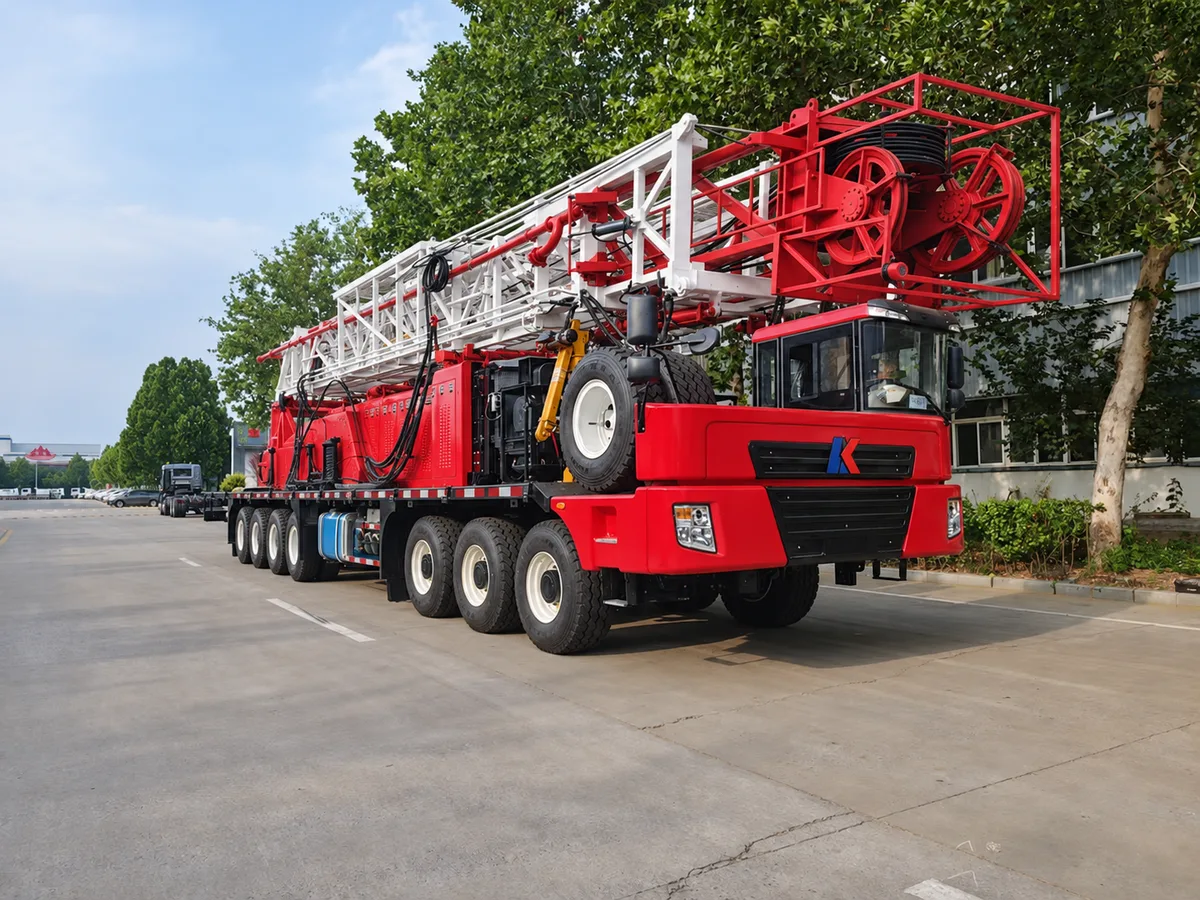
How does the 14×8 carrier affect mobility?
The published XJ750 configuration uses a dedicated seven-axle 14×8 carrier. Confirm assembled transport mass, axle loads, route limits and permits for the selected configuration.
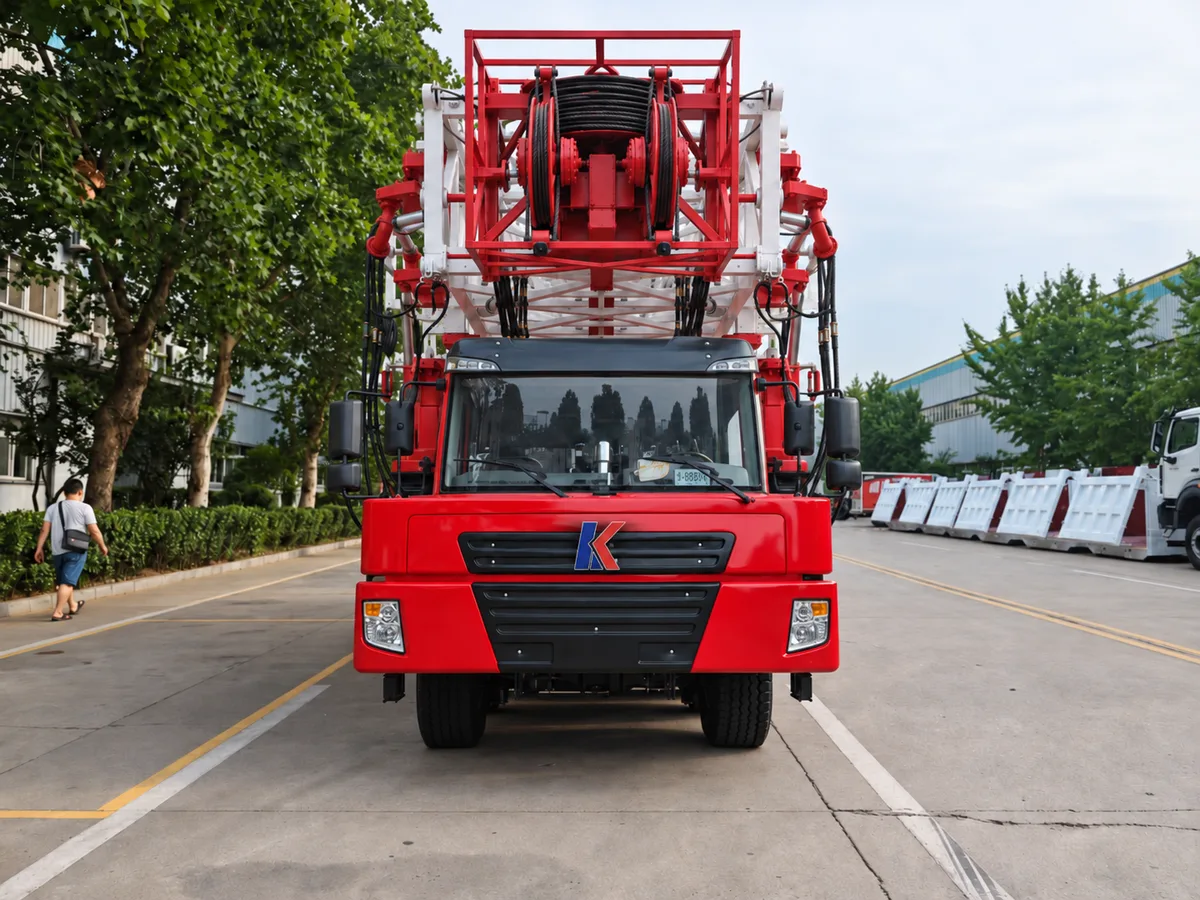
The complete-rig figures list a minimum turning diameter of 38.6 m and a minimum ground clearance of 340 mm; both may differ by tire or option. Use the turning diameter to check junctions, wellsite entrances and pad layouts on your route, and the ground clearance to judge rough lease roads and crossings. Both should be checked against the exact configuration quoted, because tires and options can change them.
How should transport and wellsite layout be planned?
Published complete-rig transport dimensions are 22.6 × 3.3 × 4.64 m. Transport mass and chassis mass terminology require clarification before route planning; published dimensions do not establish legal road transport.
On site, the 38 m mast sets the overhead clearance you need when raised and the lay-down length you need for rig-up. Plan the pad so the carrier can be positioned, the mast raised without obstruction, and pipe handled safely. For how mast height relates to stand length and racking, see Workover rig mast height and racking capacity.
Transport and wellsite checklist:
- Assembled transport mass for the exact configuration quoted
- Axle-load distribution against local road limits
- Bridge, culvert, overhead-line and turning constraints on the actual route
- Permit and escort requirements in the operating country
- Pad size, ground bearing and access for the carrier at the wellsite
- Overhead clearance and lay-down space for mast rig-up
- Space for pipe racks, ancillary equipment and safe working zones
Which operating-environment questions should be settled early?
- Ambient temperature range and any cold- or hot-climate requirements
- Engine emission requirements in the operating country
- Terrain and road conditions between yard and wellsite
- Wellsite access and rig-up space
Which documents and procurement questions belong in the enquiry?
No certification is implied by this article. For a procurement file, request:
- General arrangement drawings for the quoted configuration
- Load charts with defined rated, maximum and static loads
- Mast inspection and test records
- Powertrain datasheet for the exact engine and transmission package
- Axle-load and transport-mass statement
### Procurement question checklist
- What depth or load basis applies to our tubular, not only to 3-1/2 in drill pipe?
- What are the rated hook load, mast static load and racking capacity for the quoted configuration?
- Which engine and transmission package is quoted, and does it meet our emission rules?
- What is the assembled transport mass and axle-load distribution?
- Which options change turning diameter, ground clearance or dimensions?
- What documents, spare parts and service support are included in the scope of supply?
- Is the rig quoted new, refurbished or used, and what inspection records come with it?
The workover rig quotation checklist lists further items to include in an enquiry.
When should you look at the XJ650 or XJ1000 instead?
If your well program and string design sit comfortably within a lighter rig’s published basis, review the XJ650 workover rig. If you need more hoisting margin than the XJ750 offers for your string, review the XJ1000 workover rig. Each model’s figures carry their own tubular basis, so compare them against your string design rather than ranking models by metres. The workover rig series overview and how to select a truck-mounted workover rig give the wider selection context.
FAQ
What is the XJ750 workover depth?
The website lists the XJ750 workover depth as 6,500 m with 3-1/2 in drill pipe. Treat it as a rating stated against that specific tubular, not as a universal depth limit. If you will run a different tubular, such as EUE tubing or heavier pipe, the equivalent depth will differ, because string weight changes with tubular size, weight and grade. To judge fit, have your well engineer calculate the string load for your deepest planned run in the fluid you will use, and compare it with the rig’s load ratings. Then ask the supplier to state, in the project proposal, the depth or load basis that applies to your tubular. Suitability always depends on the confirmed well program and string design.
What is the XJ750 maximum hook load?
The reviewed page lists a maximum hook load of 1,800 kN. This is the hoisting ceiling under the supplier’s stated conditions, not a routine working load. Plan the job against a working load with a margin set by your own engineering standards, and check that stuck-pipe pulls and jarring also stay inside the rig’s ratings. The page does not publish a separate rated hook load, mast static load or setback/racking capacity, so request all three, together with the load chart for the quoted configuration and line arrangement. Comparing your calculated peak load with these confirmed figures, rather than with the maximum alone, is the reliable way to judge hoisting fit.
What engines does the XJ750 use?
The complete-rig table lists twin 540 hp or twin 550 hp engines as alternatives. Which package is delivered, and which transmission is paired with it, is confirmed by engineering for each project; the chassis-table entries should not be assumed to describe the same assembled configuration. The drawworks is rated separately at 750 hp, and engine and drawworks power should not be added together. When comparing quotations, ask for the powertrain datasheet of the exact assembled package, confirm it meets the emission rules in your operating country, and check how parts and service for that engine family will be supported locally. A listed option is not a promise of availability.
How tall is the XJ750 mast?
The published mast height is 38 m. For the wellsite, this tells you the overhead clearance needed with the mast raised and the lay-down length needed for rig-up, so check pad size, overhead lines and access before mobilising. Mast height alone does not tell you racking capacity, stand length or structural rating. Those depend on the mast design and are not published on the reviewed page, so request the mast static load, setback/racking capacity with its tubular basis, and the mast inspection and test records for the quoted configuration. Engineers should confirm that the planned stand length and pipe handling method suit the mast before the rig is selected.
What carrier is the XJ750 built on?
The published configuration uses a dedicated seven-axle 14×8 carrier. Complete-rig figures list a minimum turning diameter of 38.6 m and a minimum ground clearance of 340 mm, and transport dimensions of 22.6 × 3.3 × 4.64 m; tires and options can change these values. Use them to screen routes, junctions and lease roads, but do not treat them as proof that the rig can legally travel on a given road. Before planning a move, request the assembled transport mass and axle-load distribution for the exact configuration quoted, and confirm route limits, permits and escort requirements with the local authorities in the operating country.
Request an XJ750 configuration review
Send well depth, tubing or drill-pipe size, operating country, expected hook load if available, terrain/road conditions and new/refurbished/used preference. Emissions and chassis requirements can be added for configuration review.