
Choose a workover rig mast by checking the intended tubular handling arrangement against a dimensioned rig layout. The quoted mast height, the length of tubulars handled per lift, and the amount that can be racked are separate checks. None of these figures, by itself, confirms that the rig fits the well program.
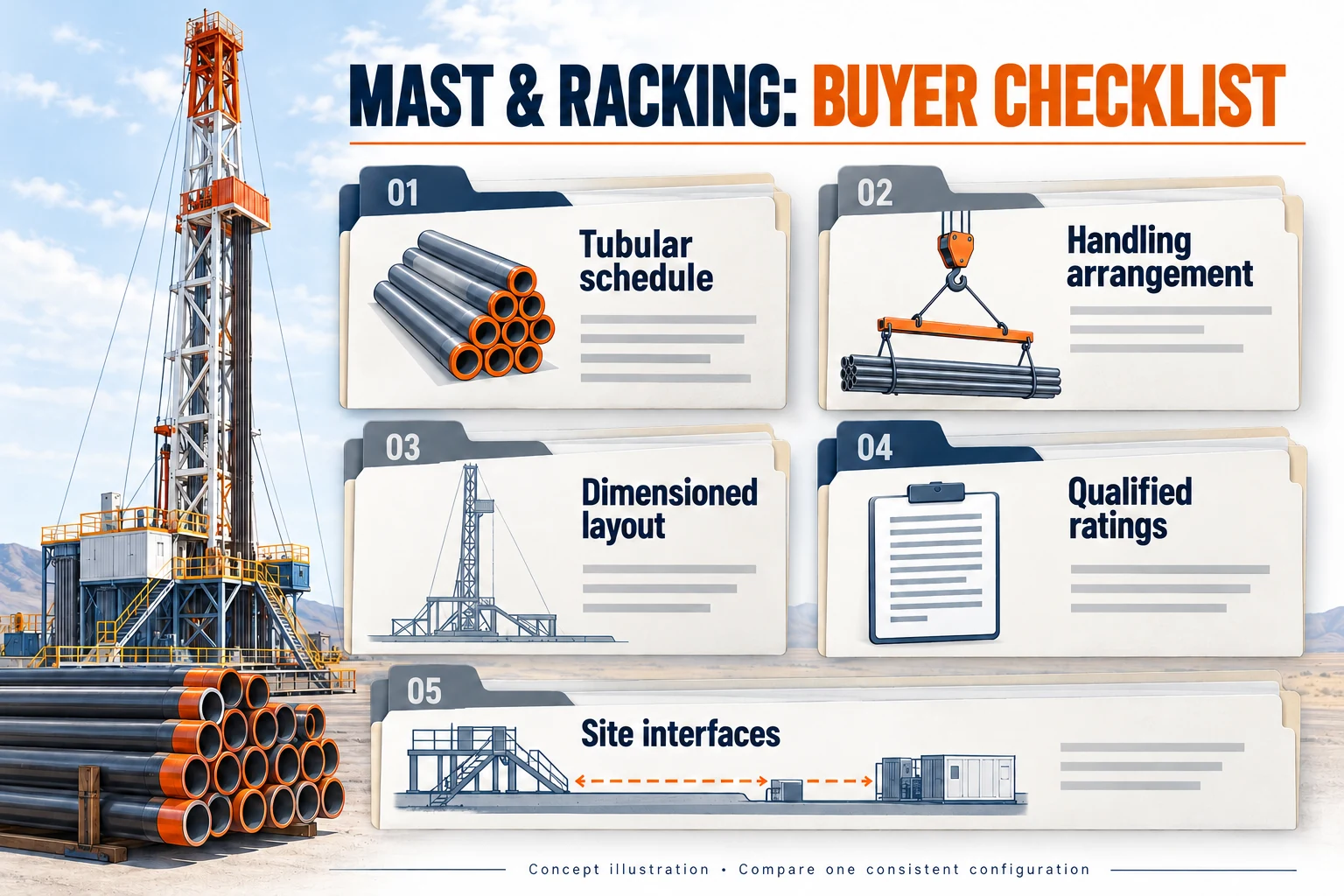
Before comparing quotations, establish three things: the longest joint or assembled stand to be handled, the definition and reference points of the quoted height, and the tubular specification behind the racking capacity. Then review the lifting equipment, wellhead arrangement and site constraints for the same configuration.
This guide explains how to turn those questions into a useful equipment enquiry. It covers selection and document review; equipment-specific operating limits must come from the approved rig documentation.
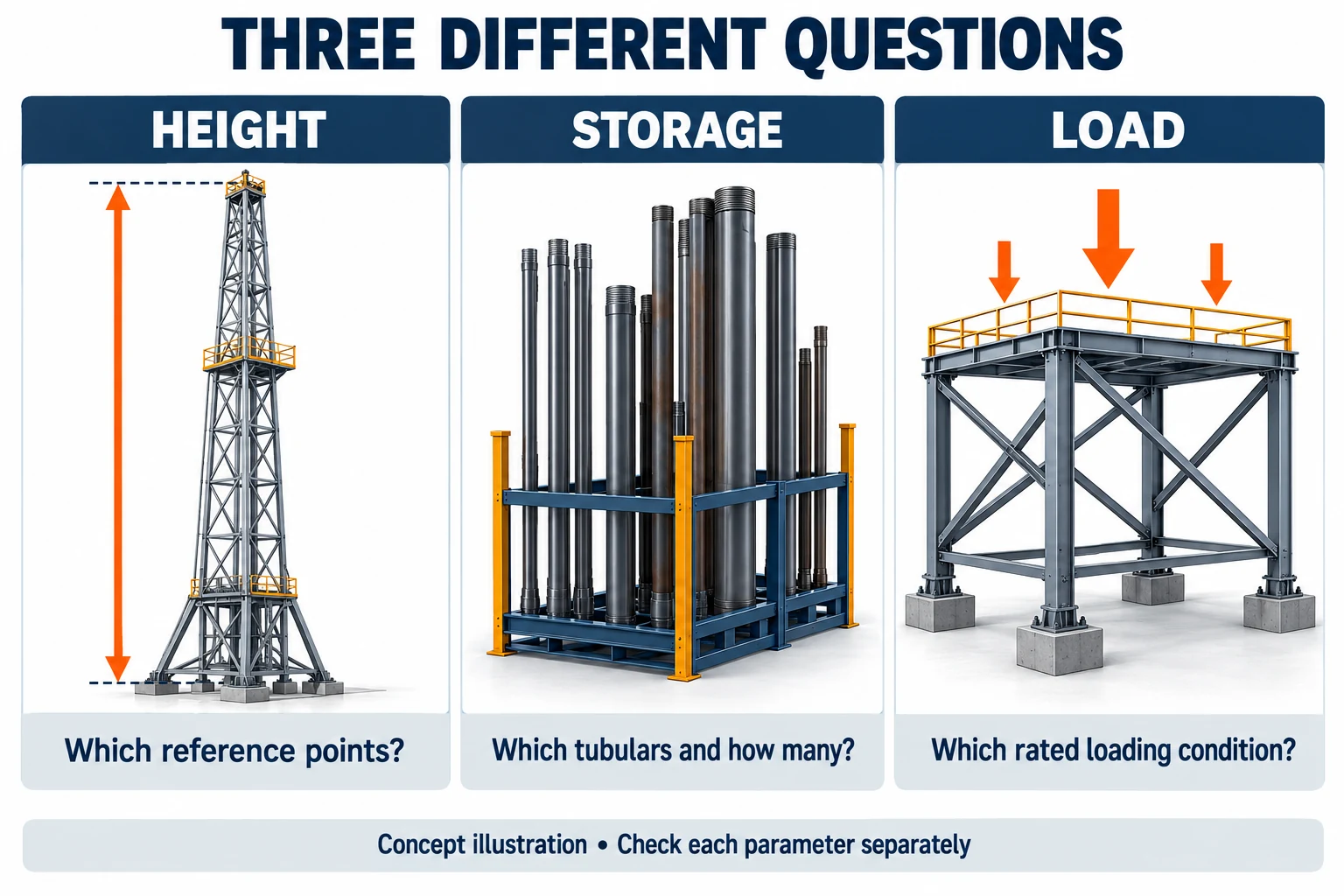
Which mast and racking terms should buyers separate?
A height describes a dimension. A racking quantity describes storage for a stated tubular arrangement. A load rating describes an allowable loading condition. Keep the supplier’s original terminology and ask for its definition before making comparisons.
| Quoted parameter | What it describes | What the quotation should identify |
|---|---|---|
| Mast height | A vertical dimension of the erected mast | Lower and upper reference points, mast position and drawing revision |
| Clear or working height | A supplier-defined usable dimension | Exact boundaries and equipment included in that definition |
| Racking-board height | Elevation of the racking arrangement | Reference level and available adjustment positions |
| Racking capacity | Storage quantity for specified tubulars | Joint or stand count, total length if used, tubular size and layout |
| Setback load capacity | A loading limit for the supporting structure | Rated location, units, configuration and permitted loading combinations |
| Hook-load rating | A hoisting rating for a defined configuration | Rating basis and relevant hoisting-system limitations |
The separation is visible in OEM documentation: NOV’s Masts and Substructures Reference Guide, PDF page 2, lists mast height, pipe racking capacity in stands, pipe setback capacity and floor height as distinct entries. That is a useful way to organize a quotation, although its drilling-rig values do not establish ratings for a workover rig. Source: NOV reference guide.
How should workover rig mast height be measured?
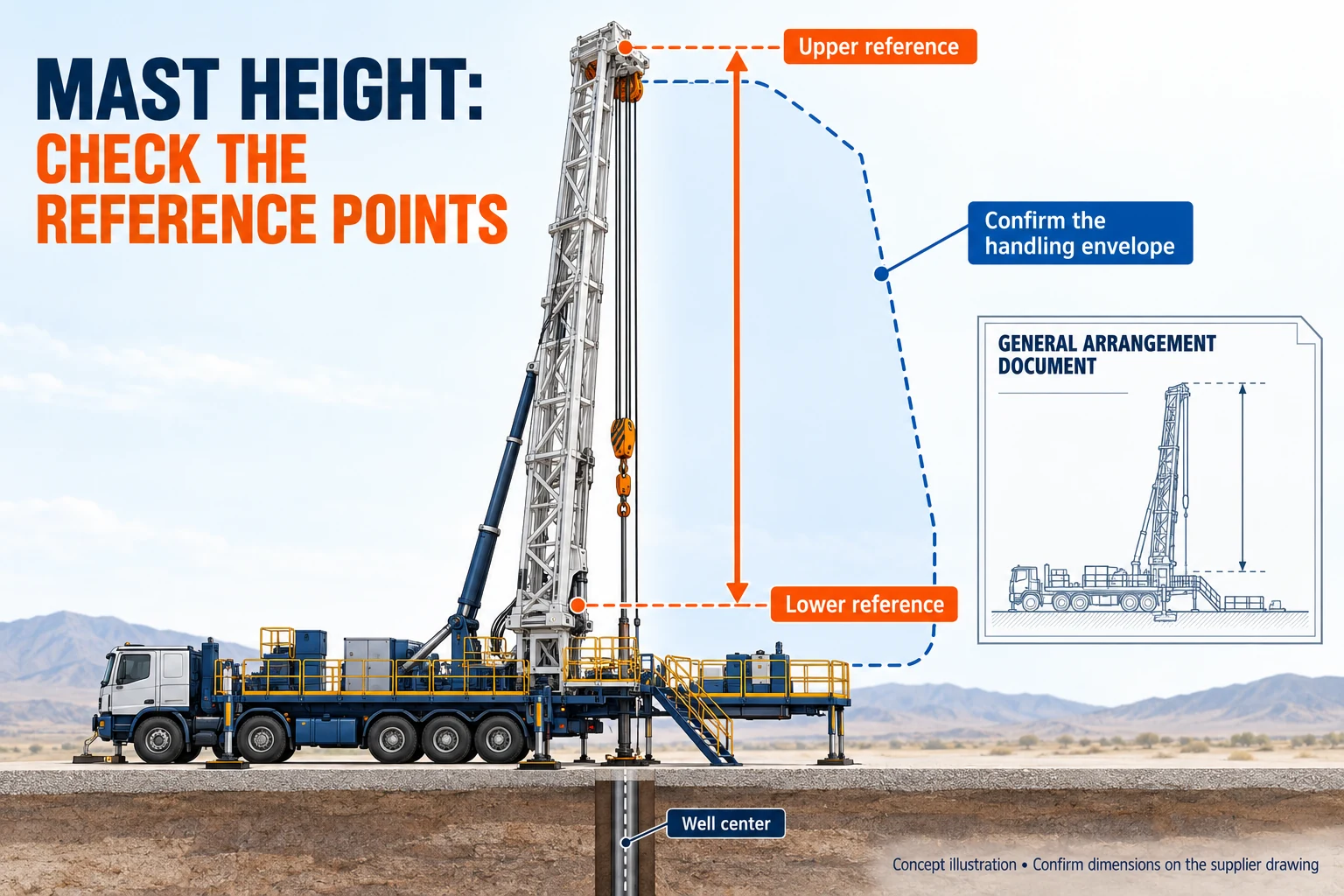
Ask the supplier to mark the stated height on a dimensioned general arrangement drawing. A number labelled “mast height” cannot be compared reliably with another supplier’s “working height” until both reference points are known.
For quotation review, request a side elevation showing the ground or support reference, work floor, well center, racking-board positions and the upper working envelope. Ask which dimension the datasheet reports and whether it changes with the proposed floor or mast configuration.
Write the requirement as a document request rather than an assumed equivalence:
“Show the quoted mast height and its reference points on the proposed general arrangement. Identify the available handling envelope with the specified traveling equipment and wellhead arrangement.”
This avoids a common comparison error: choosing the larger height figure before establishing whether the two measurements describe the same space. A photograph can help identify the general arrangement, but a perspective image cannot confirm those dimensions.
Does a taller mast automatically handle longer stands?
A longer handling arrangement requires enough usable space, but the mast’s advertised height is not a stand-length approval. Ask the supplier to confirm the intended joint or stand arrangement for the actual tubular schedule and lifting equipment.
SLB defines a drillpipe stand as connected joints retained together during tripping, distinguishing doubles and triples. This explains the terminology; it does not establish a tubing-handling capability for a particular workover rig. Source: SLB, stand.
For a workover enquiry, specify actual tubular lengths instead of relying only on labels such as “double.” Include the maximum assembled length to be handled and the relevant connection or coupling dimensions. Ask for written confirmation of the handling arrangement, including the proposed hook, links, elevators and any other equipment occupying the lifting space.
The supplier’s review should answer practical questions:
- Can the proposed arrangement handle the longest specified assembly through its required movement?
- Is the racking-board arrangement compatible with that assembly?
- Does the proposed wellhead and floor layout leave the required working space?
- What restrictions apply to different tubulars, handling tools or mast positions?
These questions form a configuration review, not a universal clearance formula. Do not subtract an assumed allowance from overall mast height and describe the result as an approved maximum stand length.
Longer stands may reduce the number of connections that must be broken and remade for a given string. They do not establish a guaranteed reduction in total workover time. Handling, inspection, well conditions and the work program still affect the operation; any productivity comparison needs a stated basis.
What does tubing racking capacity actually mean?
A racking capacity is useful only when the supplier identifies what is being stored and how the quantity is expressed. “Metres,” “feet,” “joints” and “stands” are different reporting formats. A total stored length is not the height of the racking board, and it is not an independent well-depth rating.
In conventional drilling terminology, a fingerboard organizes the upper ends of racked tubulars. SLB describes its fingers and slots as retaining the tops of drillpipe in an orderly arrangement. Source: SLB, fingerboard. For a workover rig, obtain the actual tubing or rod racking layout rather than assuming a generic drillpipe illustration applies.
Ask for a capacity statement that includes:
- Tubular type, outside diameter and relevant connection dimensions.
- Joint-length basis and joints per stand, where stands are used.
- Number of storage positions and the proposed distribution.
- Total stored length, if quoted, with its calculation basis.
- Applicable supporting-structure load limits and configuration restrictions.
A large storage-length figure does not establish the available lifting capacity. Nor does it prove that a different tubular size will fit the same layout. For the load side of selection, use the separate workover rig hook-load guide.
Can a stand count be converted into total stored length?
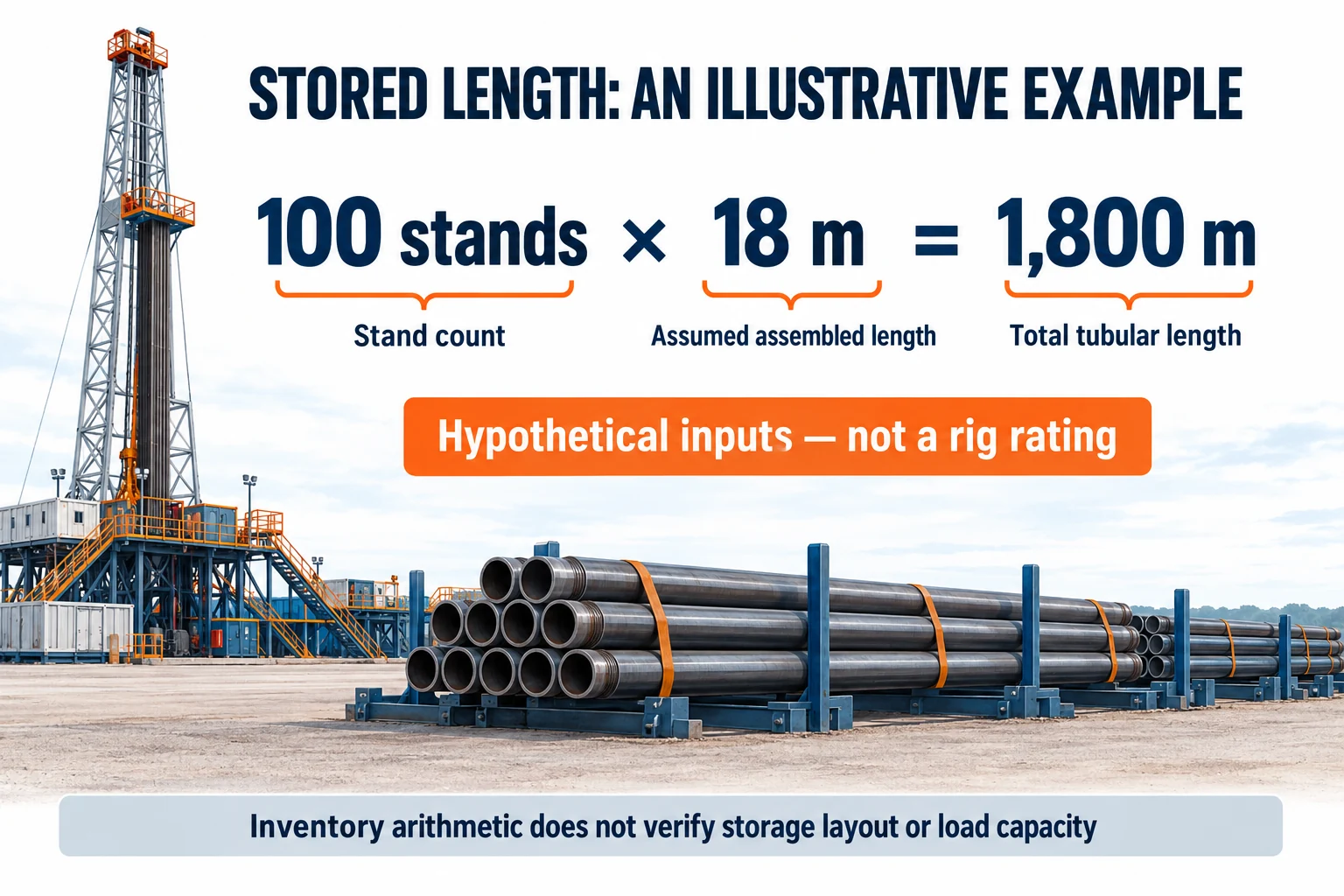
Yes, as an arithmetic description when the stand-length basis is known. For equal-length stands:
Total stored length = number of stands × assembled length per stand.
For example, 100 hypothetical stands at an assumed assembled length of 18 m represent 1,800 m of tubular length. These are illustrative inputs, not the specification of an offered rig. If actual stand lengths differ, add their individual lengths instead.
This calculation says how much length the stated inventory represents. It does not verify the number of usable positions, the stored weight, the supporting structure, or suitability for the intended operation. Those checks require the configuration documents and tubular schedule.
Why review the wellhead, floor and site at the same time?
The rig must fit the proposed well arrangement and location, as well as the tubular program. Submit a dimensioned wellhead and pressure-control-equipment layout with the equipment enquiry so the supplier can review the interfaces together.
For quotation purposes, request marked elevations and interface dimensions, access provisions, handling-space restrictions and any exclusions. Keep this layout review separate from pressure rating and well-control equipment selection; a dimensional fit alone does not approve the well-control system.
Site information also matters. OSHA’s well-servicing rig-up guidance addresses access routes, ground conditions, electrical hazards, foundations, guying and wind assessment during mast raising. These are useful enquiry subjects; the guidance does not supply a universal wind limit or foundation design for the proposed rig. Source: OSHA, transporting and rigging up a service rig.
Provide the operating location, ambient conditions, available site dimensions and transport restrictions. Request the manufacturer’s applicable erection and operating documentation, including the conditions associated with the proposed arrangement. Avoid copying a wind value, anchoring pattern or temperature range from a different rig.
How can buyers compare incomplete mast quotations?
Normalize the evidence first. The following examples are hypothetical quotation gaps, not assessments of named suppliers.
| Quotation situation | What remains unclear | Useful next action |
|---|---|---|
| Bid A gives a mast height but no dimensioned layout | Measurement reference and usable handling arrangement | Request the marked general arrangement and handling confirmation |
| Bid B quotes racking capacity as total tubing length | Tubular dimensions, stand basis, positions and loading conditions | Request a racking layout and a qualified capacity statement |
| Bid C includes a drawing and racking schedule but omits the site basis | Whether its configuration assumptions match the location | Submit site and transport information; request an exceptions list |
A more complete submission is easier to evaluate, but document quantity alone is not acceptance. Check that the drawings, data tables and quotation describe the same configuration and revision. Ask the supplier to resolve inconsistent terminology or values in writing.
If one document states a capacity in stands and another states a length, retain both original statements until their relationship is confirmed. Do not resolve a discrepancy by choosing the larger number or assuming every stand has the same length.
What should a mast and racking enquiry include?
Send the job basis and request the corresponding evidence. This makes the supplier’s response easier to compare and leaves fewer assumptions hidden in the offer.
| Buyer question | What to check | Evidence to request |
|---|---|---|
| What tubulars will be handled? | Type, OD, connection dimensions, length range and mass basis | Tubular schedule and handling scope |
| What is the longest assembly? | Maximum assembled length and intended handling method | Supplier-confirmed handling arrangement |
| What does the height figure measure? | Both reference points and erected configuration | Dimensioned general arrangement with revision |
| What can be racked? | Storage positions, stand basis, distribution and exclusions | Racking layout and qualified capacity statement |
| What loads apply? | Hoisting and storage ratings reviewed separately | Applicable rating documents and loading restrictions |
| Does the well interface fit? | Wellhead, pressure-control equipment, floor and access dimensions | Interface drawing and exceptions list |
| Does the site support the arrangement? | Ground, space, erection constraints, environment and access | Site requirements and manufacturer documentation |
| What is included in the offer? | Racking equipment, handling tools, drawings and optional items | Scope-of-supply and exclusions schedule |
| What governs acceptance and delivery? | Required document revisions, inspection scope and delivery basis | Agreed document register and commercial schedule |
Where the project specifies API requirements, identify the applicable standard and edition in the procurement documents. API identifies Specification 4F as covering drilling and well-servicing structures. A reference to that standard does not itself verify the compliance or certification of an offered mast. Source: API Specification 4F.
Use the workover rig model comparison to begin a model enquiry, then request the configuration documents for the particular offer. Model names and headline dimensions are starting points for review.
Frequently asked questions
Is mast height the same as tubing racking capacity?
No. Mast height is a dimension; tubing racking capacity describes storage for a stated tubular arrangement. Ask for the height reference points and the racking quantity’s units and conditions.
Can I select a workover mast from well depth alone?
No. Well depth is one job input. Supply the tubular schedule, intended handling arrangement, load requirements, well interface and site conditions so the proposed configuration can be reviewed.
Does a double-stand description confirm the maximum tubing length?
No. Request the actual maximum assembled length and the compatible handling and racking arrangement. A stand label does not replace a dimensioned configuration review.
Does a racking capacity in metres describe rack height?
Not necessarily. It may describe total stored tubular length. Ask the supplier to define the field and identify the tubular size, stand basis and storage layout.
Can arithmetic confirm a racking rating?
No. Multiplying stand count by assembled length describes inventory length only. Storage positions, load limits and configuration suitability need separate evidence.
Which documents matter most before accepting an offer?
Request a consistent set: the dimensioned general arrangement, tubular handling confirmation, racking layout, qualified capacity statements, applicable rating documents, interface drawing and scope-of-supply schedule.
Prepare the configuration enquiry
Include the tubular schedule, longest assembly, planned storage arrangement, wellhead layout and site information in your equipment enquiry. Ask the supplier to identify its assumptions, exclusions and document revisions alongside the quoted mast and racking figures. That provides a clearer basis for technical comparison than a height or capacity number on its own.
2 thoughts on “Workover Rig Mast Height and Racking Capacity: A Buyer’s Guide”
Comments are closed.