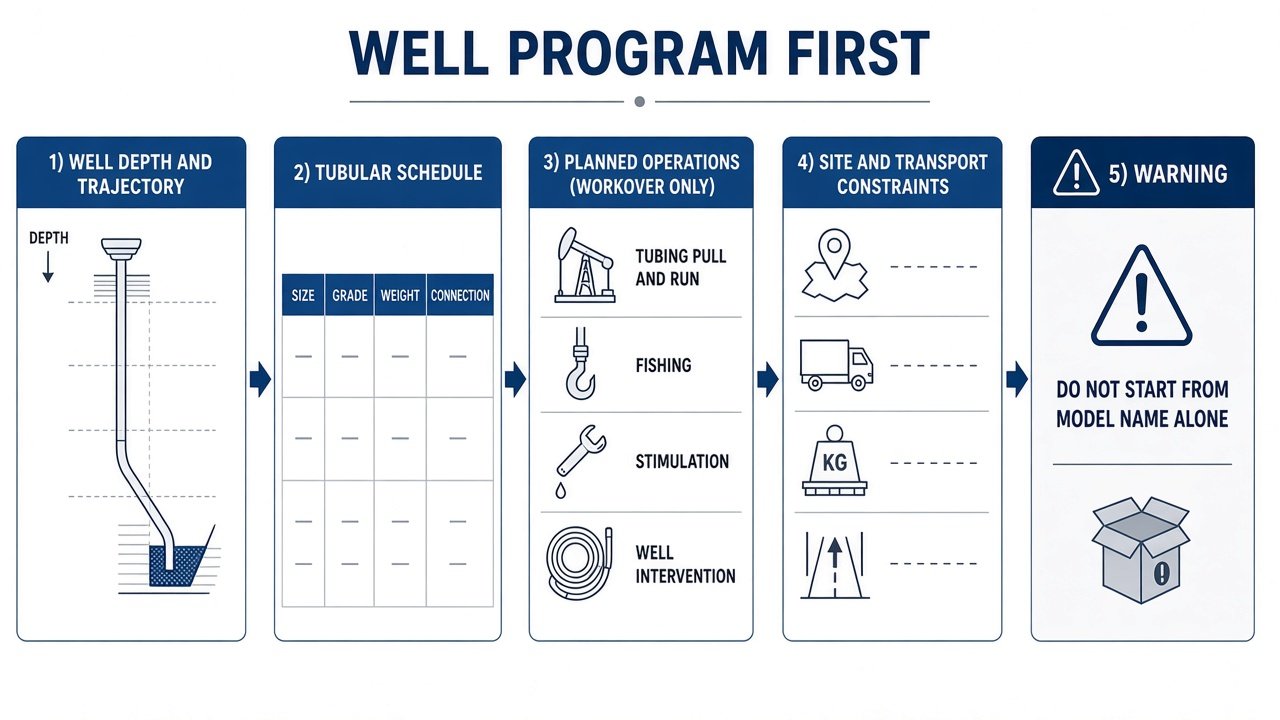
Short answer: Select a truck-mounted workover rig by starting from the well program, not from a model name. Define the deepest and heaviest job, the tubular string and its connection, the hook load and mast load the job requires with a safety margin, then the carrier, climate and road constraints, and finally the documents the supplier must sign. A rated depth or a rated load on a brochure is a starting point for discussion; it does not by itself prove suitability for a specific well.
This guide is written for workover contractors, oilfield service companies, EPC teams and procurement or tender engineers. It explains the order of decisions and what to ask for at each step. It does not rate any specific rig for any specific well.
What should be defined before comparing workover rigs?
Direct answer: Define the job first: well depth and trajectory, the tubular schedule (size, grade, weight and connection), the planned operations, and site and transport constraints.
A workover is the repair or stimulation of an existing well, or the major maintenance or remedial treatment of an oil or gas well, and it often involves pulling and replacing production tubing (SLB Energy Glossary: workover). Because the rig mainly lifts, holds and racks a tubular string, the string itself sets the load case.
Conditions and limitations: Deviated and horizontal wells, stuck-pipe risk and fishing operations can raise the required pull well above the string’s simple weight. These cases must be stated by the operator’s engineering team; they cannot be inferred from a generic guide.
How do you translate the well program into hook load and mast requirements?
Direct answer: Estimate the maximum expected hook load for the heaviest string and the worst planned operation, add the operator’s required design margin, and compare that result with the supplier’s documented hook, mast and drawworks ratings under the stated conditions.
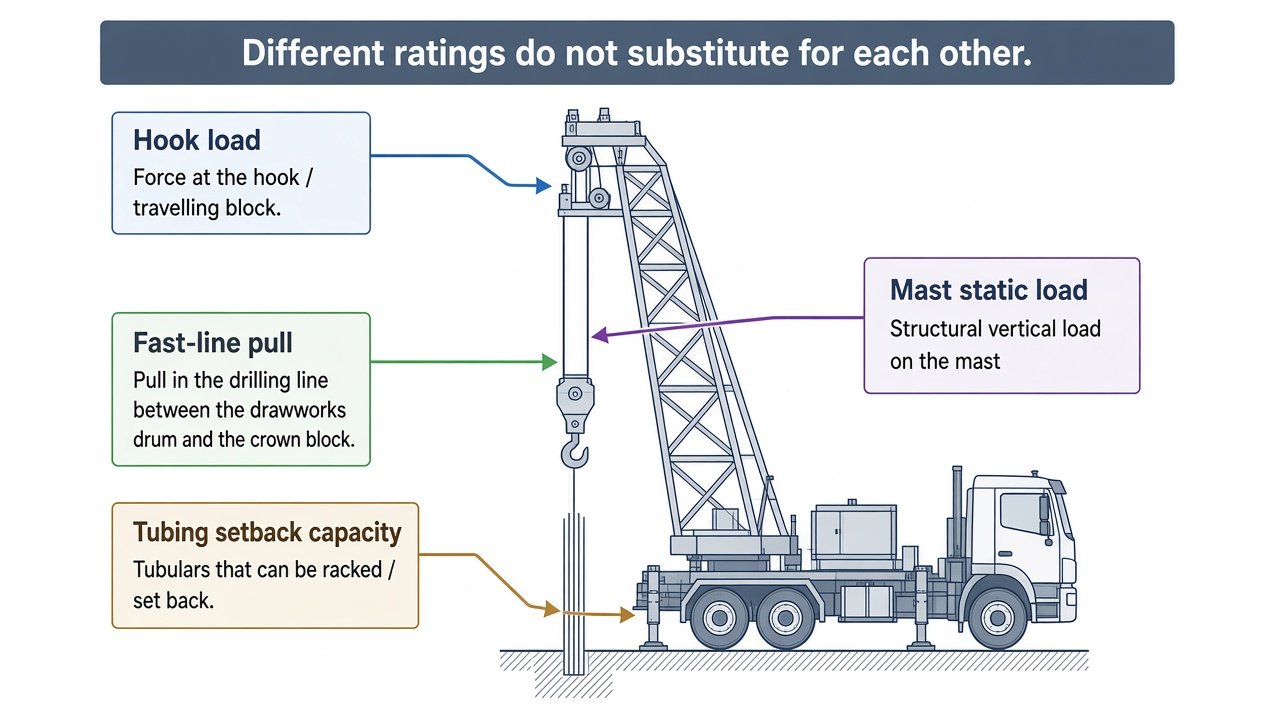
Hook load is the total force pulling down on the hook, including the weight of the string in air and ancillary equipment, reduced by effects such as buoyancy and increased or reduced by wellbore friction, especially in deviated wells (SLB Energy Glossary: hook load). The mast is the structure that supports the crown block and the string; on land rigs it is laid down when the rig moves (SLB Energy Glossary: mast). The drawworks reels the drilling line in and out over the crown and travelling blocks (SLB Energy Glossary: drawworks).
Conditions and limitations: Hook load, mast static load, fast-line pull and tubing setback capacity are different ratings. Do not treat one figure as a substitute for another. For a deeper explanation see workover rig hook load explained and workover rig mast height and racking capacity.
How should a rated workover depth be read?
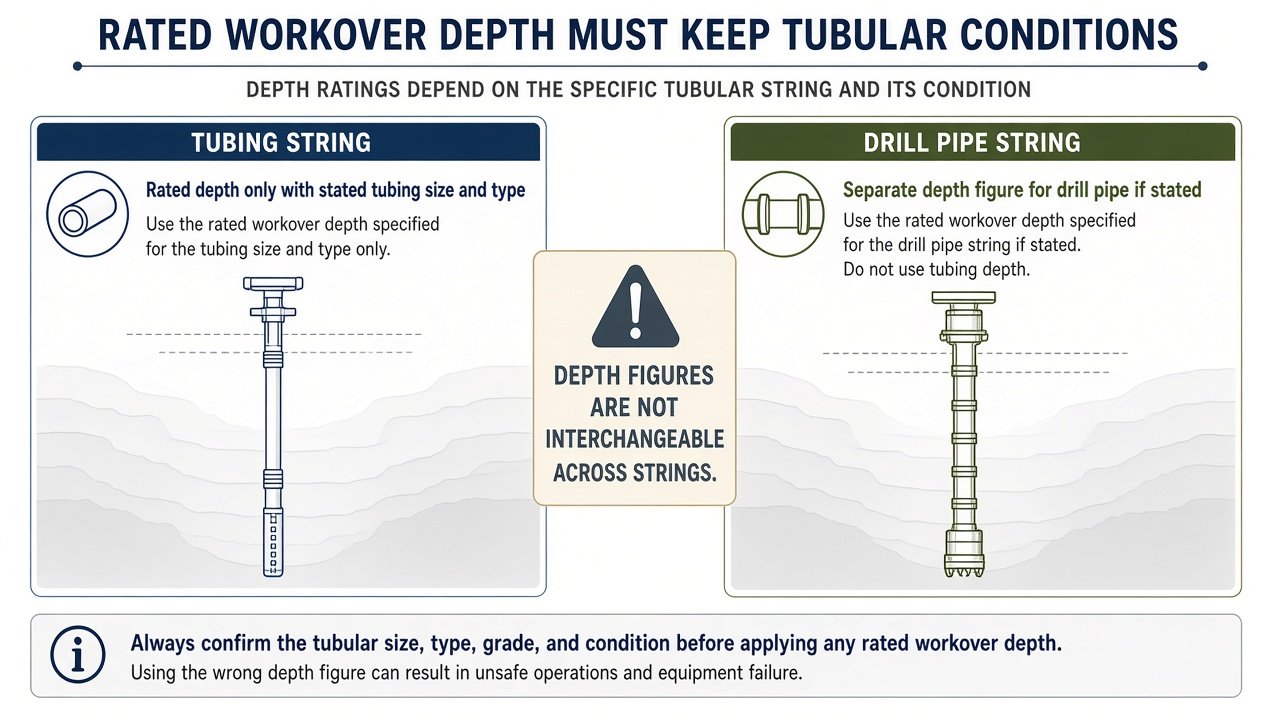
Direct answer: Read a rated depth only together with the tubular size and type it was stated for. A depth stated for one tubing size or for tubing rather than drill pipe does not transfer to another string.
The same rig can carry different depth figures for tubing, drill pipe and racking length, and those figures mean different things. Ask the supplier to state each depth figure with its tubular size, connection type and basis of calculation. Worked examples for specific models are discussed in XJ550 workover rig specifications explained and XJ650 workover depth and EUE tubing.
Conditions and limitations: Rated depth is not a guarantee for a particular well. Actual suitability depends on the well program, tubular schedule, required hook load, operating environment and project specifications.
Which carrier, engine and transmission questions matter?
Direct answer: Choose the carrier from the routes and sites the rig must reach and the legal limits on those routes, then confirm that the engine, transmission and drawworks package delivers the required line pull for the load case.
Ask for the axle configuration, gross vehicle weight and axle loads, overall dimensions in transport mode, turning and gradient capability, and the engine and transmission make, model and emission standard. Check these against local road regulations, bridge limits and site access. Planning considerations for off-road access are covered on the high-mobility oilfield chassis planning page.
Conditions and limitations: Axle configuration and power package options differ by model and by order. Do not assume an option is available for a model until it appears in the signed configuration sheet.
How do climate and site conditions change the specification?
Direct answer: Specify the ambient temperature range, dust or sand exposure, altitude and any hazardous-area requirements in the enquiry, and ask the supplier which cooling, filtration, cold-start and electrical packages are offered for those conditions.
Desert, high-temperature and cold-climate operation affect engine cooling, air filtration, hydraulic fluids, batteries and steel selection. A rig is not suitable for a region simply because it has been marketed there; project-specific evidence is needed.
Which documents should the supplier provide before purchase?
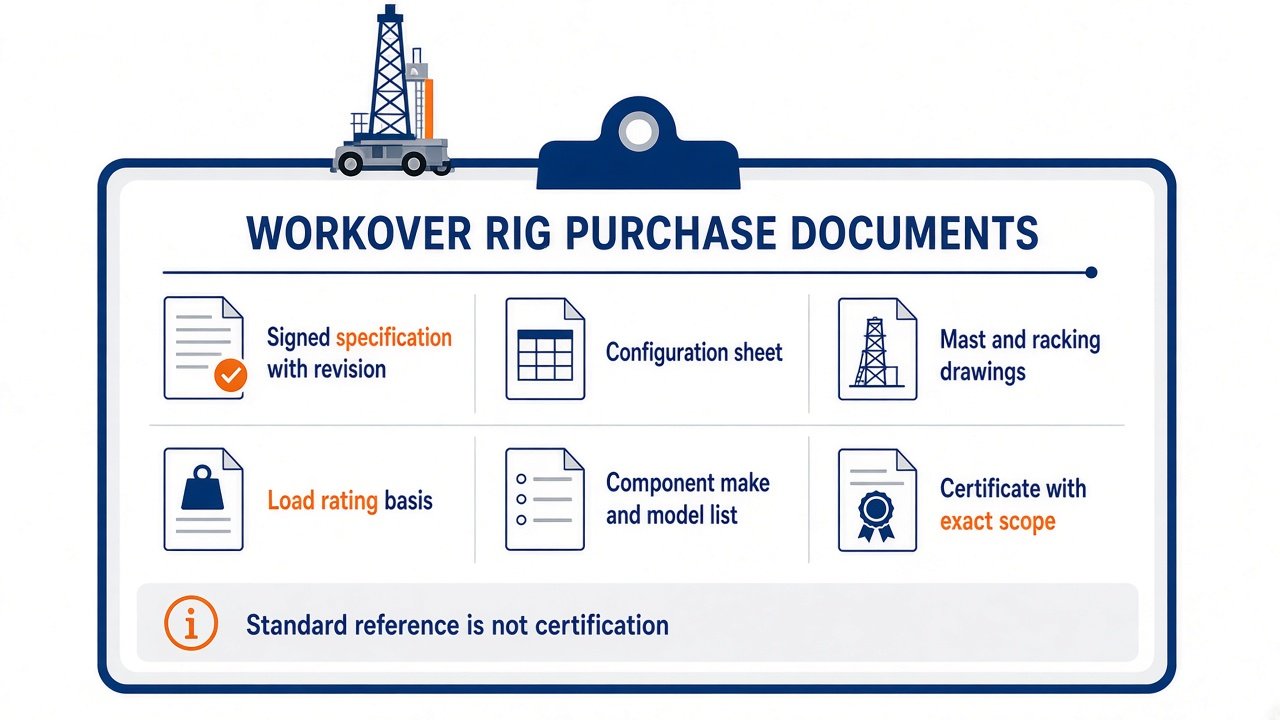
Direct answer: Ask for a signed specification with revision, a configuration sheet, mast and racking drawings, load rating basis, component make and model list, a deviation list against your tender, and any certification documents with their exact scope.
Referencing an industry standard is not the same as being certified to it. API, for example, runs separate licensing and certification programs such as the API Monogram (API Monogram and APIQR); if your tender requires a specific certificate, ask for the certificate itself, its number, scope and validity, and check it with the issuing body. A full list of quotation inputs is in the workover rig quotation checklist.
Buyer decision table: selecting a truck-mounted workover rig
| Buyer question | What to check | Why it matters |
|---|---|---|
| What is the deepest, heaviest job? | Well depth, trajectory, tubular size, grade, weight and connection | Sets the load case for every other rating |
| Is the hook load enough? | Calculated maximum hook load plus required margin versus the documented hook load rating and its conditions | Hook load is reduced or increased by buoyancy and friction |
| Do mast and racking fit the string? | Mast static load, clear height, setback or racking capacity for the actual stand length and tubular | These are separate ratings from hook load |
| Does the rated depth apply to my string? | Tubular size and type behind each depth figure | Depth stated for one string does not transfer to another |
| Can the carrier reach the site legally? | Axle configuration, axle loads, transport dimensions, route and bridge limits | Road and site access often decide the carrier |
| Is the power package matched? | Engine and transmission make, model, emission standard; drawworks line pull | Line pull must match the load case |
| Is the rig fitted for the climate? | Cooling, filtration, cold-start and electrical packages offered for stated ambient conditions | Regional marketing is not suitability evidence |
| Are certificates real and in scope? | Certificate copy, number, scope, validity; confirmation with issuer | A standard reference is not a certification |
| What deviates from my tender? | Written deviation list and signed configuration sheet | Prevents surprises at acceptance |
Buyer checklist before requesting a quotation
- Well program and trajectory for the target wells
- Tubular schedule: size, grade, weight per foot, connection type
- Planned operations, including any fishing or stuck-pipe contingency
- Required hook load and design margin set by your engineering team
- Mast, racking and stand-length requirements
- Carrier and road constraints: axle limits, transport dimensions, routes
- Ambient conditions: temperature range, dust or sand, altitude
- Required standards and certificates, with the exact scope needed
- Delivery, spare parts, training and after-sales expectations
Where does the Hubei Link range fit?
Hubei Link Petroleum Equipment lists XJ550, XJ650, XJ750 and XJ1000 truck-mounted workover rigs on its workover rigs page. Model listings are a starting point for an enquiry, not a confirmation that any model or configuration suits your well. To receive a configuration proposal, send the checklist above through the contact page; a proposal should come back with a signed specification and configuration sheet you can check against your well program.
For guidance organized by well program, climate and site access, explore our workover rig solutions by operating condition.
Frequently asked questions
What is the first step in selecting a workover rig?
Define the well program and tubular schedule. The deepest and heaviest planned job sets the hook load, mast and depth requirements that every rig option must meet.
Is a rig’s rated depth enough to decide if it suits my well?
No. A rated depth applies to the tubular size and type it was stated for. Suitability depends on the well program, tubular schedule, required hook load, operating environment and project specifications.
Are hook load and mast capacity the same thing?
No. Hook load is the force on the hook from the string and equipment, while mast static load, line pull and setback capacity are separate ratings that each need to be checked.
Does a reference to an API standard mean the rig is API certified?
No. Ask for the certificate itself, its number, scope and validity, and check it with the issuing body.
Does a model listing confirm that a rig suits my well?
No. A model listing is a starting point for an enquiry, not confirmation of suitability. Review the proposed signed specification and configuration sheet against your well program.