

For a useful workover rig quotation, provide the planned job, well data, tubular schedule, required loads, site and transport conditions, and the equipment and services you expect in the offer. Attach the available well program and project specifications, identify their revisions, and list any information still awaiting confirmation.
You can begin an enquiry before every detail is settled. The important step is to distinguish confirmed requirements from preliminary inputs and questions requiring engineering review. A model name and a depth figure alone leave too much of the quotation basis undefined.
This guide offers a buyer preparation framework for equipment procurement. It is not a rig selection calculation, an operating procedure or a mandatory industry checklist.
What should the first enquiry contain?
Start with a short project brief that allows the supplier to understand the work and identify missing information. Include the destination, intended operations, available well and tubular data, quantity, equipment condition requested, and target delivery point and date.
For example, a useful opening could read: “Please review the attached well program and tubular schedule for a truck-mounted workover rig proposal. The operating location and route constraints are attached. Load calculations remain under review; please identify the information needed to complete configuration selection.” This gives the supplier a defined task without turning an incomplete input into an accepted requirement.
If you have a preferred model, identify it as a starting point for review. The workover rig model range can help frame the discussion, but the offered configuration still needs to be matched to the project.
Use the well-program selection guide to review how the planned operation shapes the equipment package. The checklist below turns that selection discussion into a documented enquiry, with input status, supply boundaries and open items that buyers can track across quotation revisions.
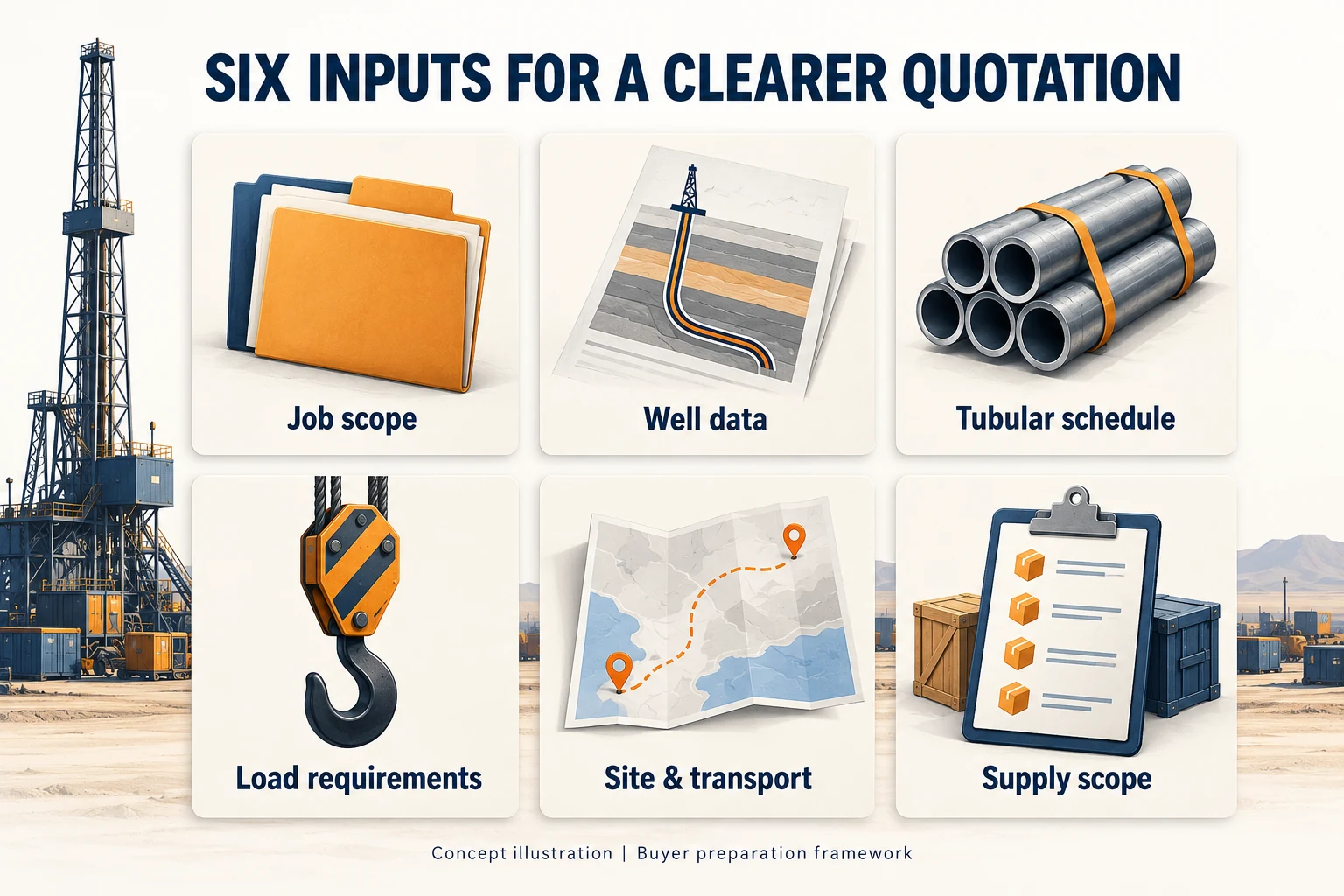
Which job and well details should buyers prepare?
Describe what the rig will do: tubing pulling and running, rod servicing, completion work, or other specified intervention tasks. Identify additional duties separately, including any proposed rotational or pumping work. Ask the supplier to confirm the required equipment and operating limits for each duty rather than assuming that every workover rig has the same capabilities.
Provide the well schematic and relevant work program. State the working interval, well trajectory, casing and completion restrictions, and available wellhead and pressure-control interface information. Mark which documents are current and who can answer technical questions.
Where available, attach a dimensioned wellhead and proposed pressure-control stack arrangement, connection references and required working clearances from the project documents. Mark missing interface dimensions as open items for joint review rather than asking the supplier to infer them from a photograph.
Label depth values explicitly. SLB distinguishes measured depth, which follows the wellbore, from vertical depth. Its depth reference entry also explains the reference point from which a depth is measured. Put the depth type, datum and units beside the value in the enquiry.
For several wells, attach a schedule showing the range of duties. Identify the cases your engineering team considers relevant to selection, and ask the supplier to record which cases its proposal covers. A single maximum-depth entry does not describe all the differences between those wells.
What belongs in the tubular schedule and load requirement?
Prepare a separate entry for each tubular type and section. Record outside diameter, nominal mass per unit length, grade, connection, section length and planned quantity where available. Include tools or assemblies relevant to the proposed handling arrangement, together with the source document and revision.
Keep tubular inventory and design load requirements in separate fields. The supplier needs to know both what will be handled and the load basis against which the offered system will be reviewed. Do not substitute an unreviewed pipe-weight estimate for an approved lifting requirement.
On small screens, scroll the table horizontally to view all columns.
| Input | What to record | Supporting document or clarification |
|---|---|---|
| Well depth | Depth type, datum and units; relevant working interval | Well schematic or approved well program |
| Tubular size | Outside diameter for every relevant section; label mm or in | Tubular specification or schedule |
| Tubular mass and length | Mass per unit length (kg/m or lb/ft), section lengths (m or ft), and quantities | Material specification and tally, where available |
| Grade and connection | Exact designation; special handling restrictions if specified | Tubular or connection documentation |
| Required loads | Load definition, force units (such as kN or lbf), load case and approval status | Engineering calculation or project requirement |
| Handling and storage | Joint or stand arrangement, proposed stored quantity and layout needs | Handling plan and dimensioned layout |
Ask the responsible engineer to identify the applicable normal and exceptional load cases, including any required pulling allowance, and document the basis. If that work is incomplete, write “load basis pending engineering confirmation” and request a clarification list. Do not select an arbitrary allowance to make the enquiry appear complete.
When the supplier responds, request a configuration-specific explanation of hook-load, mast and hoisting-system limits and their conditions. The existing hook-load guide covers the distinctions in more detail; this enquiry should carry the project inputs those distinctions depend on.
Which configuration and site constraints affect the quotation?
Give the supplier the available space, wellhead interface information, access route and project environmental requirements. Request a general arrangement drawing showing the proposed equipment footprint, clearances and relevant interfaces for review.
For tubular handling, specify the intended joint or stand arrangement and whether storage on the rig is required. Ask for the corresponding dimensional and qualified load information. The mast-height and racking-capacity guide explains the separate questions to resolve before accepting a storage description.
For the site and transport route, prepare the available pad information, ground assessment, route survey, access restrictions and destination requirements. OSHA’s site-preparation guidance identifies access-road and pad preparation as site-specific activities. It provides background for asking about these interfaces; it does not approve the proposed rig or determine local requirements outside its jurisdiction.
State the required ambient operating range and known dust, altitude or other environmental conditions from project documents. Ask the supplier to identify the proposed engine, transmission, drawworks, cooling and filtration arrangements, together with the relevant limitations and maintenance provisions. A destination country alone is insufficient to define an environmental package.
List chassis preferences separately from confirmed transport constraints. Request the proposed carrier arrangement, transport dimensions and axle-load information for route review. Road access, registration and permit requirements should be confirmed for the actual destination and route; an axle description alone does not resolve them.
How should buyers define the supply boundary?
List each item as supplier scope, buyer scope or unresolved. This is especially useful for well-control equipment, pumps, tanks, handling tools, power supply, site works and installation support. Identify connection and responsibility boundaries as well as the equipment names.
State the documentation and acceptance requirements in the enquiry. Ask the quotation to identify the supplied technical specification, drawings, manuals, inspection and test records, spare-parts list, and proposed acceptance activities. Define any third-party inspection and witness requirements with the responsible project team.
If a project invokes API Specification 4F, identify the required edition and scope for review. API’s official announcement identifies its subject as drilling and well servicing structures. That reference does not establish certification of a particular rig. Request evidence that matches the quoted equipment and the exact project requirement.
For commercial scope, request separate confirmation of equipment condition, quantity, delivery basis and named place, packing, freight responsibility, offer validity and payment terms. Ask which event starts the proposed lead time and which technical approvals it depends on. Define requested commissioning, training, warranty and parts support explicitly so the supplier can state what is included, optional or excluded.
If used or refurbished equipment is acceptable, add asset identity, available history, inspection findings, proposed work and acceptance requirements. Keep those requests tied to the individual unit; do not assume a standard refurbishment scope or standing availability.
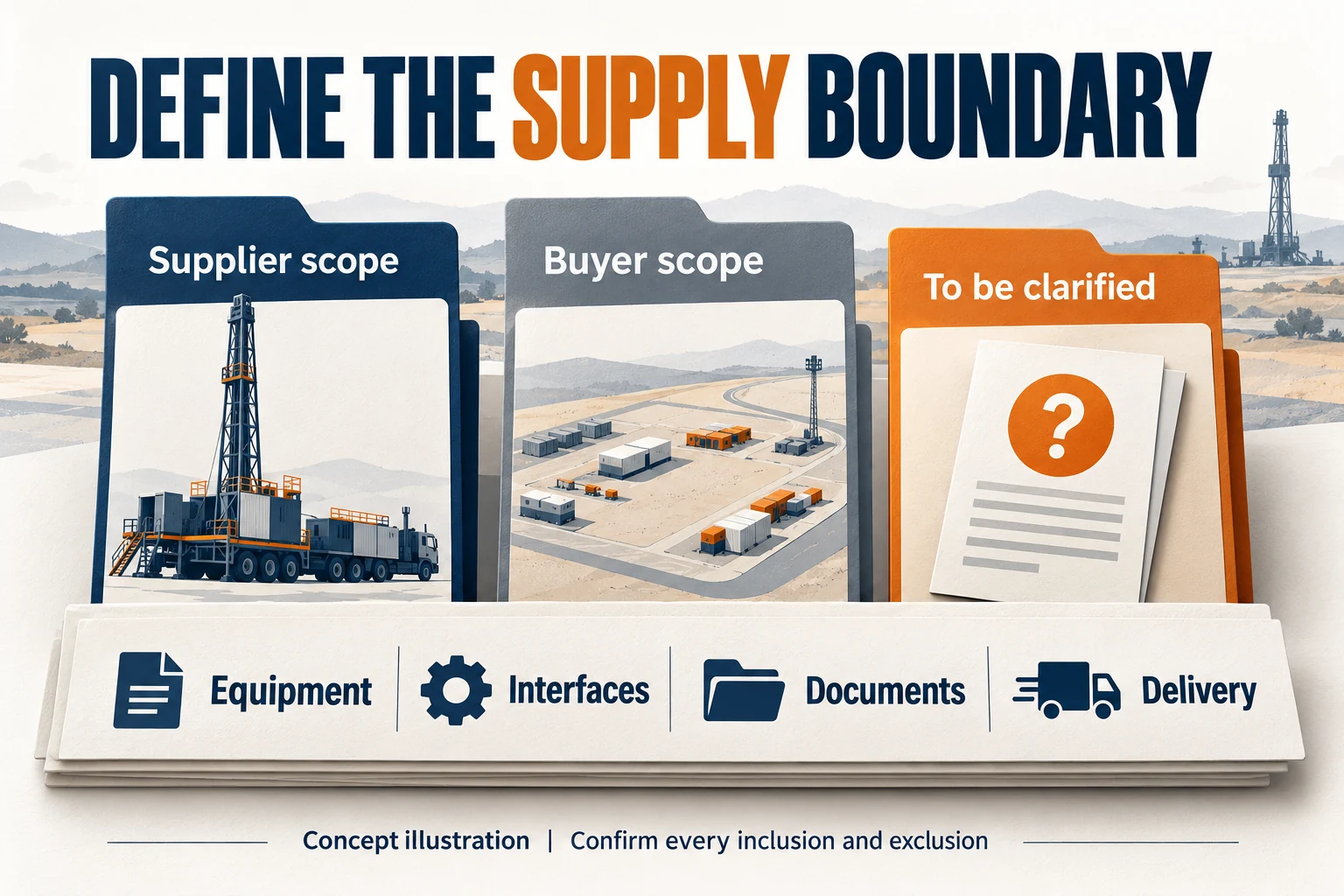
Can buyers use a ready-to-fill enquiry checklist?
Use the following table as an attachment or copy it into an enquiry. Add a document reference and status for each entry: confirmed, preliminary or pending review. The fields are procurement recommendations; the responsible project team should adapt them to the work.
On small screens, scroll the table horizontally to view all columns.
| Buyer question | What to provide or check | Your input / document reference |
|---|---|---|
| What work must the rig perform? | Operations, well count, intended duty and any additional functions | To complete |
| Which wells define the selection basis? | Well schematics, working intervals, depth types, datums and trajectory data | To complete |
| What tubulars and assemblies will be handled? | Outside diameters (mm or in), mass per unit length (kg/m or lb/ft), grade, connections, lengths (m or ft) and quantities | To complete |
| Which loads must be reviewed? | Load definitions, force units, cases, calculation references and approval status | To complete |
| How will tubulars be handled and stored? | Joint or stand arrangement, storage requirement and layout constraints | To complete |
| Which power and transmission requirements apply? | Project requirements or request for a documented supplier proposal | To complete |
| What are the site and environmental conditions? | Pad and ground information, space, wellhead/stack layout, connection references, clearances, ambient range and other specified conditions | To complete |
| What constrains transport? | Route information, dimensional and axle-load restrictions, destination requirements | To complete |
| What must the supplier include? | Itemized equipment, interfaces, spare parts and service scope | To complete |
| Which documents and acceptance activities are required? | Project specification, applicable standards, records, inspection and witness requirements | To complete |
| What are the commercial requirements? | Quantity, condition, named delivery point, requested date and quotation basis | To complete |
| What remains open? | Missing information, responsible reviewer and expected confirmation date | To complete |
How should missing information and supplier assumptions be handled?
Keep a short open-items register with the enquiry. Ask the supplier to identify every assumption that affects configuration, price or schedule and state what would change when the assumption is resolved.
On small screens, scroll the table horizontally to view all columns.
| Open item | Useful supplier response | Buyer follow-up |
|---|---|---|
| Load basis not approved | Identify missing inputs and label any preliminary selection | Obtain engineering review before configuration acceptance |
| Transport route not finalized | Provide proposed dimensions and axle-load information for review | Confirm route and destination constraints |
| Auxiliary scope unresolved | Itemize inclusions, exclusions, options and interface responsibilities | Agree a common supply boundary |
| Acceptance requirements incomplete | State the proposed inspection and test scope and exclusions | Review against project requirements |
Use one enquiry revision when requesting comparable offers. If the well program or supply scope changes, issue the revision to each supplier and request confirmation of its effect. Preserve the earlier assumptions so the comparison can be traced.
Before accepting a configuration, reconcile the quotation, technical specification, drawings, exclusions and clarification record. Any material disagreement should remain an open item until resolved in the project documents.

Frequently asked questions
Can I request a quotation before the load calculation is finished?
Yes. Request a preliminary discussion or budget offer, identify the missing load basis and ask what information is needed. Any preliminary configuration should remain subject to engineering confirmation before acceptance.
Is well depth enough to select a workover rig?
No. Include the planned operations, tubular schedule, required loads, handling arrangement and site constraints. Keep the depth type, datum and units attached to every depth value.
Should I specify a model in the first enquiry?
You can name a preferred model for discussion. Ask the supplier to explain its proposed configuration against the attached project requirements and identify deviations or unresolved items.
Does an enquiry need every supporting document immediately?
No. Send the available project brief and documents, then identify the missing items and their reviewers. Agree which inputs are required for a preliminary offer and which must be confirmed before configuration acceptance.
How can I make quotations easier to compare?
Give suppliers the same enquiry revision and request itemized equipment, interfaces, documents, exclusions and assumptions. Compare the technical basis and supply boundary before comparing the total price.
Prepare your workover rig enquiry
Send the completed checklist, available well program and tubular schedule through the Hubei Link equipment enquiry page. Include the project location, requested delivery point and date, and the items still awaiting review. Request a configuration-specific proposal with its assumptions, exclusions and supporting documents so your technical team can assess it against the intended work.
1 thought on “What Information Should You Provide When Requesting a Workover Rig Quotation?”
Comments are closed.