
Accept a refurbished trailer-mounted coiled tubing unit against an agreed equipment list, a documented refurbishment scope and recorded inspections and tests for the actual unit. The acceptance package should connect each major component to its identity, condition, repair history and applicable operating limits. Separate acceptance for shipment from approval to mobilize and operate at a particular well.
For a semi-trailer package, review the trailer and transport interfaces alongside the reel, injector, power supply, controls and any supplied tubing string and pressure-control equipment. A running demonstration gives useful evidence for the functions demonstrated; the acceptance decision also needs the supporting documents and unresolved-item record.
This guide is for procurement teams, contractors and technical reviewers. It describes what evidence to request and assess. Test procedures, limits and acceptance tolerances must be established for the equipment by the responsible technical parties.
Which equipment is actually included in the refurbished package?
Begin with the configuration being offered, including items supplied separately. Record whether the package includes the tractor, semi-trailer, reel, injector and gooseneck, hydraulic power supply, operator cabin, hose reels, tubing string, pressure-control equipment and handling equipment. Assign a serial or other traceable identity to each applicable item.
ICoTA’s equipment overview identifies the reel, injector, controls, power pack and pressure-control equipment as distinct parts of a coiled tubing system. Trailer arrangements also vary: NOV’s trailer-mounted unit description illustrates different transport and power-supply arrangements. These references help identify interfaces; their specifications do not establish the configuration of another manufacturer’s equipment.
Make the power boundary explicit. A trailer may depend on a tractor-mounted hydraulic supply, a separate power pack or another arrangement. A workshop demonstration using a temporary power source leaves the buyer to confirm the compatibility and availability of the power source intended for delivery.
A coiled tubing pumping support truck is a separate equipment scope. Its pumping specifications do not describe the reel capacity, injector performance or tubing condition of the trailer-mounted unit addressed here.
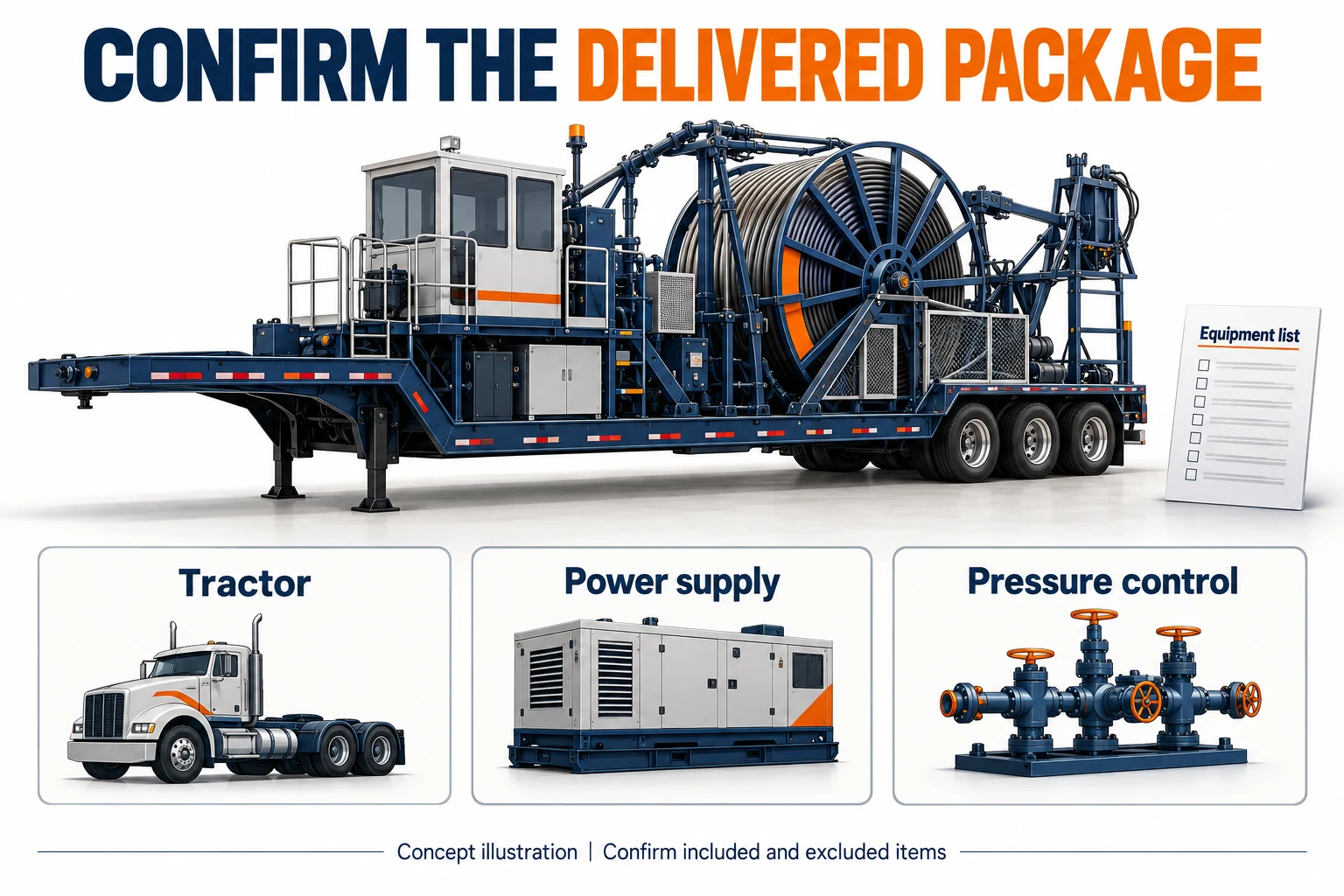
How can a specification help without becoming a universal acceptance standard?
Use the specification supplied with the offer as a list of commitments to verify. Identify its revision and reconcile it with the as-built equipment, refurbishment agreement and approved deviations.
For illustration, an SLG450T reference specification describes a new semi-trailer-mounted package. It supplies examples of the distinctions a buyer should examine, rather than acceptance limits for every refurbished coiled tubing unit. No particular refurbished asset is cleared by the examples below.
On small screens, scroll the table horizontally to view all columns.
| Reference configuration example | What the buyer should distinguish | Acceptance evidence to request |
|---|---|---|
| A reel-capacity entry lists 7,600 m for 1.5-in tubing; a separate supplied-string entry lists 5,000 m of 1.5-in tubing | Reel storage capacity and the tubing actually delivered are separate commitments | Actual reel configuration, string identity, delivered length and applicable tubing specification |
| The overall injector description covers several tubing sizes, while factory-installed handling and pressure-control parts are described for 1.5-in tubing | A size range does not establish readiness for every size in that range | Installed grippers, guide arrangement, stripper elements, rams and any changeover parts for the ordered size |
| Separate entries address transport weight, individual axle capacity and support jacks | Transport loading and operating support require different assessments | Actual transport loading condition, axle and kingpin loads, support arrangement and approved limitations |
| Some components have hazardous-area descriptions; other electrical equipment is expressly described as non-explosion-proof | A component marking does not classify the whole package | Area classification, installation arrangement, component evidence and compatibility review |
The example source specifies new, unused equipment. Preserve that original record and define the refurbished supply condition in a separate, agreed component-by-component register of new, repaired, inspected and retained items. Resolve configuration differences in writing before acceptance.
What should the refurbishment dossier prove?
Ask for a traceable work history for the offered unit: the pre-refurbishment condition assessment, agreed work scope, work completed, parts fitted, inspections performed and final configuration. Record any unavailable history as a gap with an agreed disposition.
Use a work register with columns for component identity, initial finding, action, replacement-part identity, inspection or test reference, and outstanding limitation. An engine overhaul record concerns that engine; it does not establish the condition of the injector, trailer structure or tubing string.
For structural or pressure-containing repairs, request the applicable repair basis and supporting inspection records. Ask the responsible reviewer to establish where access, disassembly, measurements or nondestructive examination are required. The dossier should identify inspection coverage and limitations as well as results.
Keep original manufacturing records, current repair records and post-refurbishment test reports distinguishable. A historical certificate can support identity and original design information, but the buyer still needs evidence for the current condition and offered configuration.
How should the semi-trailer and equipment mountings be assessed?
Have the relevant trailer specialist inspect the frame, kingpin and upper coupling area, suspension, axles, brakes, tyres, electrical and air connections, and landing or support equipment as fitted. Include equipment mounting points, structural modifications, transport restraints, platforms, access and guards in the agreed scope.
The UK’s heavy goods vehicle inspection manual treats trailer inspection as a defined technical activity. It is a jurisdiction-specific reference, not a universal import or road-approval standard. Confirm the requirements for the actual destination, tractor combination and route separately.
Request a transport loading statement identifying what is aboard: tubing, injector, pressure-control equipment, fuel, accessories and other carried items as applicable. Obtain the axle and kingpin loading basis and measured weights where required by the agreed acceptance plan. An empty or partly equipped trailer weight does not establish the loading of the delivered combination.
Distinguish landing legs used for parking from supports approved for operating loads. If hydraulic supports, mechanical locks or support pads are fitted, request their condition records, functional checks and approved operating arrangement. Do not infer site support capacity from the number of jacks alone.
For lifting points, handling frames, injector supports or cranes included in the offer, request identification, applicable load documentation, repair history and inspection evidence. Confirm who provides any separate handling equipment needed to install or operate the package.
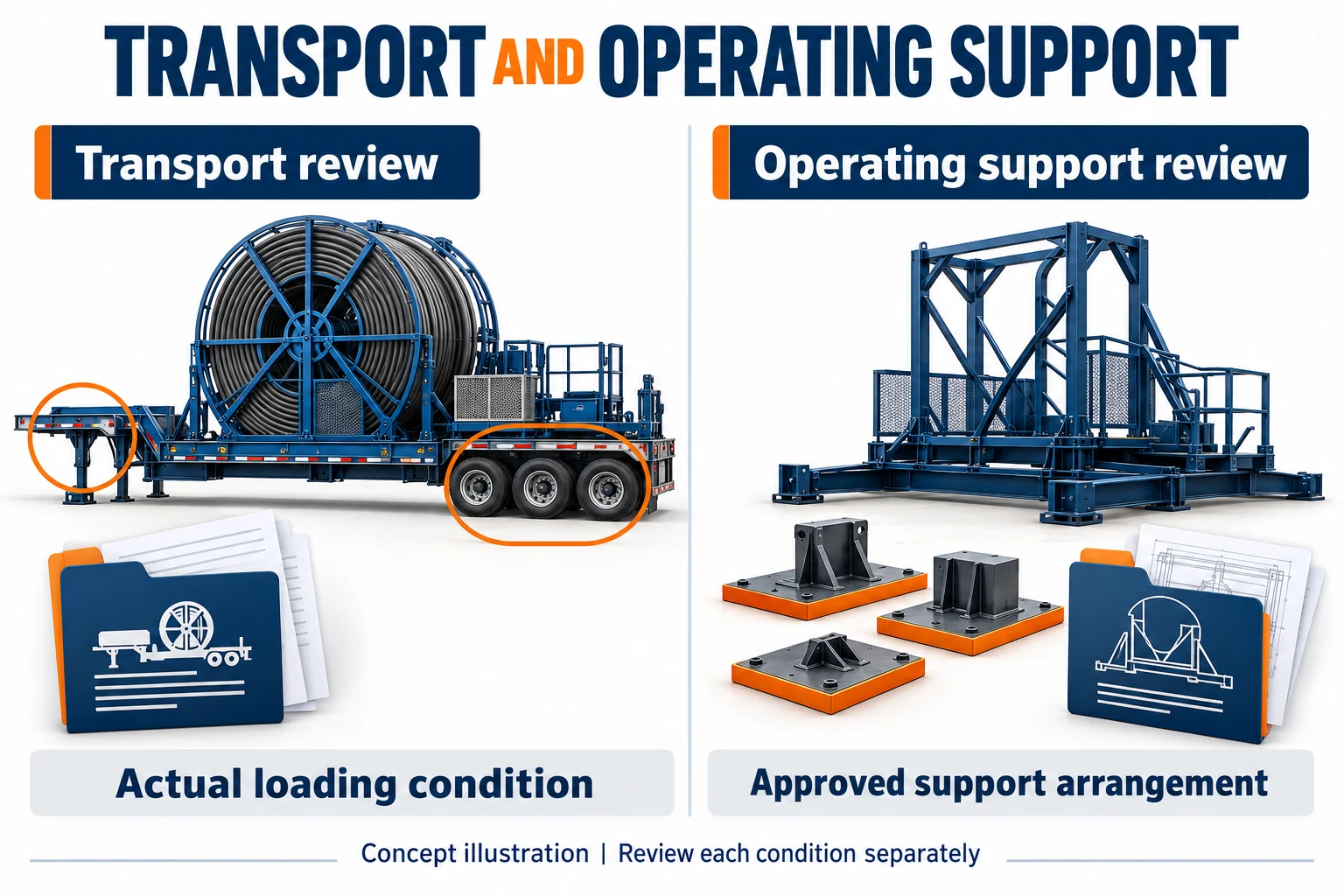
What should the reel and injector acceptance cover?
Review the installed equipment against its own documentation and the intended tubing size. For the reel, ask for evidence covering its structure, drive, brake, level-wind system, guide components, transport restraint and associated pressure-containing flow path where fitted. Inspect and test these functions under the agreed procedure and defined conditions.
For the injector, the review should address chains, grippers, traction and tension systems, guides, drive components, brakes, lubrication and instrumentation as applicable. Record the installed gripper size and the condition or replacement history of relevant wear components. Require the applicable manufacturer’s criteria for assessing condition and performance.
Agree how load, direction, speed control, holding and specified emergency functions will be demonstrated. The report should state the test arrangement, tubing or test fixture used, measurement method, conditions, acceptance criteria and actual results. A no-load demonstration does not verify rated load performance.
Keep continuous pulling capability, injecting or snubbing capability, speed and structural or handling ratings separate. Request the conditions and limitations attached to each offered value; do not assume maximum load and maximum speed are simultaneously available.
How should an included used tubing string be evaluated?
Treat the tubing string as a separately identified asset. Request its manufacturing specification, grade, diameter, wall-thickness or taper schedule, length, weld and repair records, available service history, fatigue-management records and latest inspection results. Link the records to the string being delivered.
SLB’s tubing-integrity discussion describes wear and fatigue associated with loading and repeated movement on and off the reel. It distinguishes operational-history tracking from inspection of tubing condition. Both are relevant when assessing the evidence available for a used string.
Refurbishing the trailer or changing the reel’s drive components does not reset the service history of retained tubing. If part of a string has been removed, repaired or replaced, ask how the remaining string and its history are identified and updated.
Have the responsible tubing specialist review the available history, inspection coverage, proposed service and acceptance criteria. Missing history should remain an explicit technical gap. A pressure-test result alone does not establish a defined remaining fatigue life, and an unsupported percentage of remaining life should not become a purchase acceptance statement.
If the offer excludes tubing, record that exclusion and confirm which reel, injector and pressure-control configuration will be reviewed when the buyer selects a string.
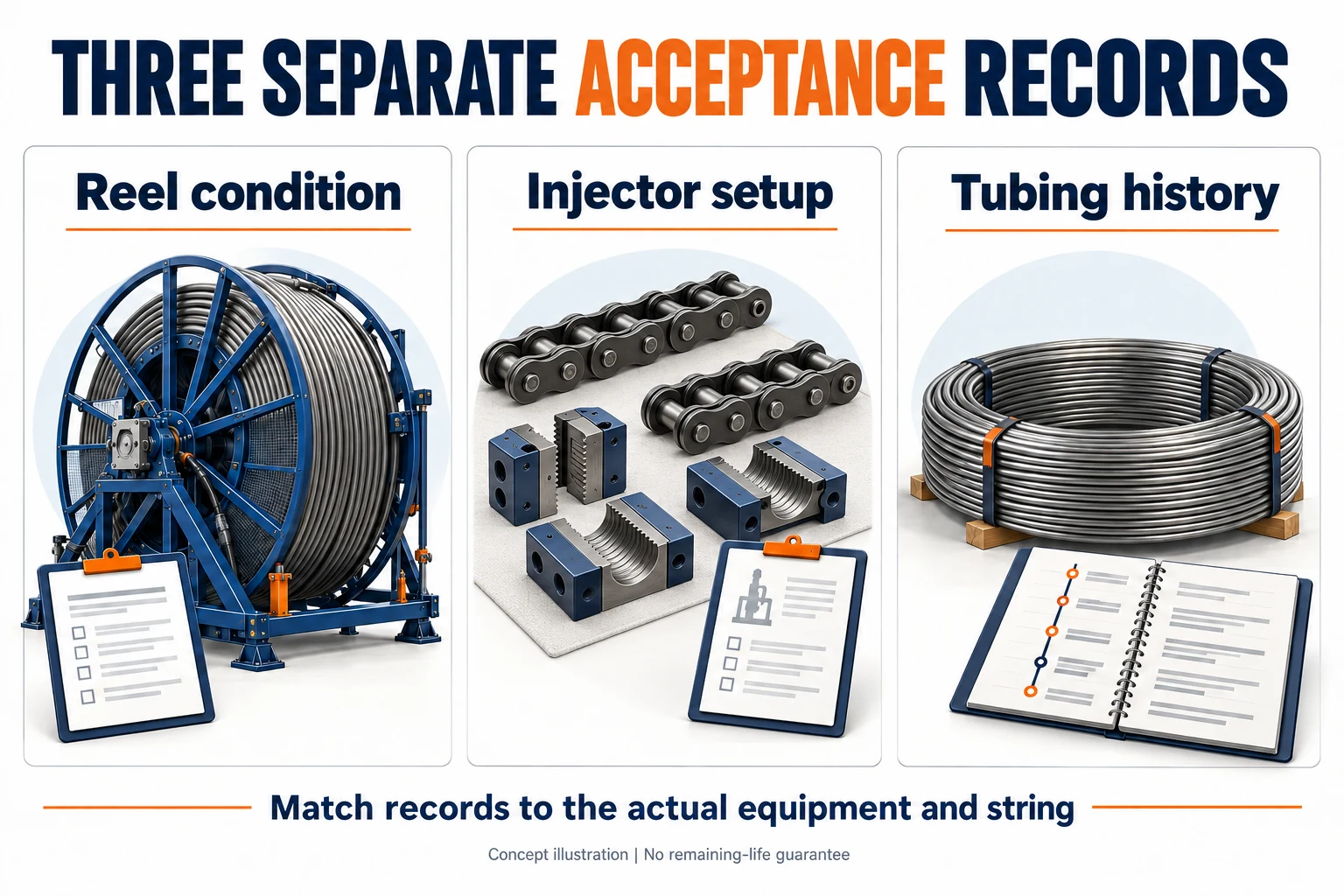
What evidence is needed for pressure-control and hydraulic systems?
Identify each supplied pressure-control item and its configuration, including the BOP arrangement, stripper, lubricator, connectors and associated controls where included. Reconcile bore and connection details, tubing-size-dependent parts, working ratings, temperature and fluid-service requirements with the project and the component records.
Clarify whether a listed BOP is additional equipment, an alternative configuration or a replacement for another listed item. A general description and a detailed equipment list may need reconciliation; do not silently assume that every option is included.
For retained or repaired pressure-containing equipment, request the repair history, inspection records, applicable material and service evidence, and approved test basis. Separate pressure containment, functional operation and any required shear-performance evidence. Have the responsible well-control reviewer establish the tubing and equipment configuration to which any shear evidence applies. A routine function or pressure test should not be described as demonstrating shear capability unless that specific evidence has been established for the relevant configuration.
API’s digital catalogue identifies RP 16ST as addressing coiled tubing well-control equipment systems. The responsible parties should determine the applicable documents, editions and requirements. A standard named in a specification does not itself prove certification or conformity of the delivered equipment.
Pressure testing requires a defined system of work. HSE’s GS4 guidance addresses risk assessment, written test arrangements and safeguarding. Ask the test organization to establish the applicable test boundary, medium, pressures, duration, instruments, criteria and records. This article supplies no universal test-pressure multiplier or hold time.
Review hydraulic hoses, fittings, routing, protection, identification, contamination controls, leaks and the functions of fitted accumulators and backup controls against the approved scope. Keep hydraulic control pressure, well-fluid working pressure, instrument range and test pressure distinct in the records.
How should controls, data and the power supply be demonstrated?
Request functional and measurement checks for the installed control arrangement. Where fitted, these may include load indication, depth and speed measurement, pressure channels, alarms, emergency shutdown functions and backup controls. Agree the relevant operating states and expected responses before testing.
For a data-acquisition system, request a sample recorded run that connects the displayed values to the sensors, channel names, units, timestamps and saved output. Review calibration references, units and channel scaling, and confirm that records can be retrieved after the demonstration.
If tubing-life or job-analysis software is included, confirm the supplied version, authorized access, licence-transfer conditions, usable hardware and availability of the actual string data. An installed software icon is insufficient evidence that the buyer can use the supplied system and records after handover.
For the engine, hydraulic power pack, generator or tractor-dependent supply, request the recorded maintenance and repair scope, operating observations and test results against the agreed duty. Confirm fuel, electrical and hydraulic interfaces and any project environmental limitations. A workshop run under local conditions does not demonstrate every claimed ambient operating condition.
Which checks belong in the acceptance plan?
Agree the inspection and test plan before witnessing the final demonstration. Each applicable item needs an acceptance basis, evidence, responsible reviewer and disposition. The following is a procurement framework to adapt, not a substitute for the actual manufacturer’s limits or a project test procedure.
On small screens, scroll the table horizontally to view all columns.
| Buyer question | What to check | Evidence and release decision |
|---|---|---|
| Is this the agreed asset and configuration? | Trailer and major-component identities; supplied and excluded items | Reconciled equipment list and identification record |
| What refurbishment was completed? | Findings, retained items, repairs, replacements and deviations | Work register linked to component records |
| Is the trailer ready for the proposed transport review? | Structure, coupling, running gear, restraints and actual loading condition | Trailer inspection and loading documents; destination review separately |
| Are supports and handling arrangements documented? | Fitted supports, locks, mounting points and included lifting equipment | Inspection records and approved arrangement; unresolved limits held open |
| Does the installed injector match the ordered tubing? | Grippers, guides, traction, brakes, instrumentation and specified performance | Configuration-specific inspection and witnessed test results |
| Is reel operation and its flow path documented? | Drive, brake, level wind, restraints, swivel and piping as fitted | Applicable inspection, functional and pressure-boundary records |
| Is included tubing suitable for technical review? | Identity, dimensions, history, fatigue records and inspection limitations | Specialist disposition for intended service; gaps explicitly recorded |
| Is pressure-control equipment traceable? | Actual stack, seals, rams, connections, service conditions and repair scope | Item-specific records and agreed tests; separate shear evidence where required |
| Are measurements and controls trustworthy? | Calibration references, channel mapping, alarms, backup functions and data output | Recorded demonstration against agreed criteria |
| Is the intended power source part of the tested package? | Supply scope, interfaces, maintenance and duty limitations | Identified power source and relevant test results |
| Can the buyer maintain and operate the delivered configuration? | Current manuals, drawings, parts, software access and agreed support | Handover document and spares reconciliation |
| Are outstanding items closed or formally dispositioned? | Nonconformities, corrective work, retests and release authority | Signed closure record and clear shipment or operational release boundary |
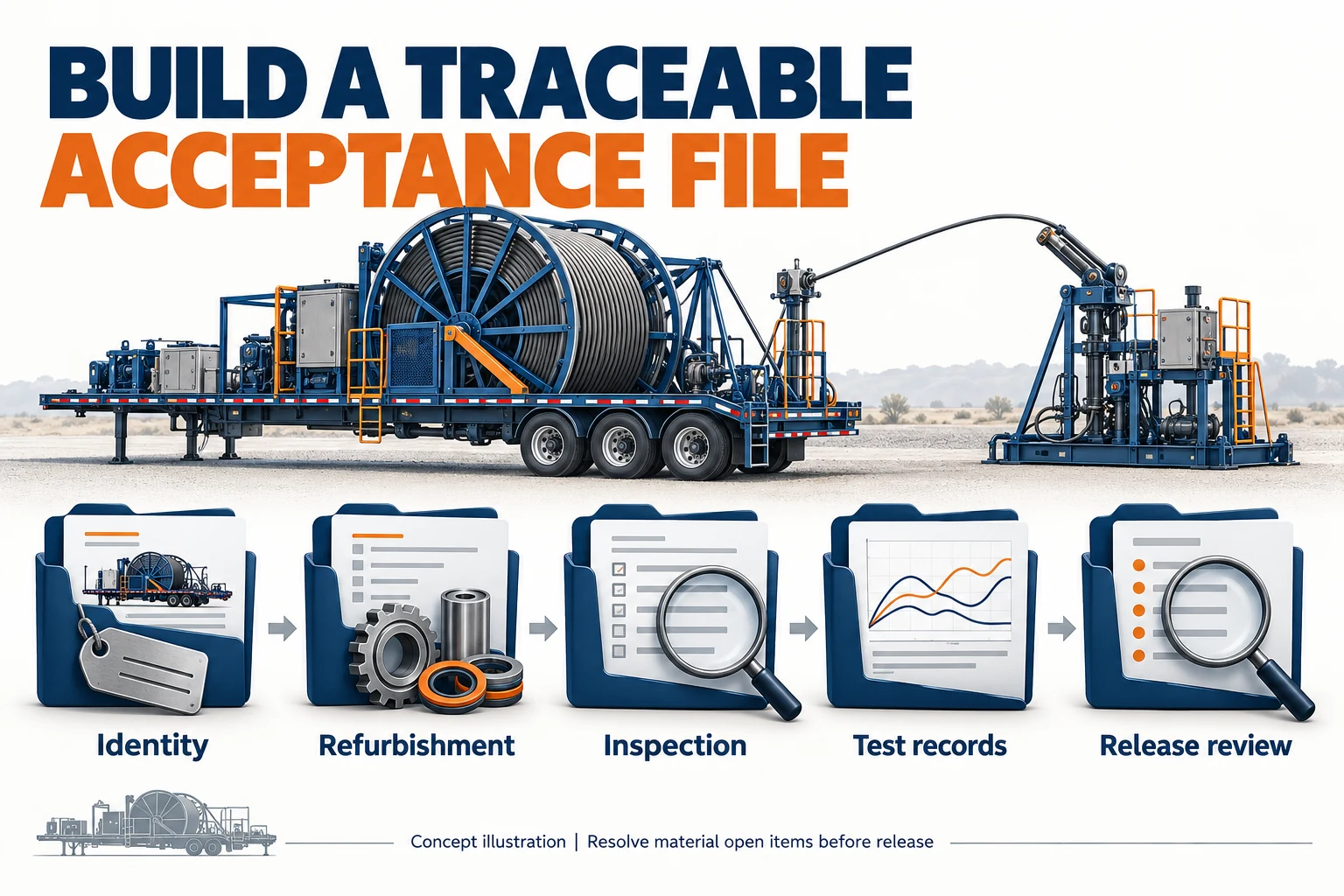
When should acceptance remain open?
Keep material identity discrepancies, unresolved structural or pressure-integrity findings, unverified critical functions and missing evidence needed for the intended service open for technical disposition. Record the affected item, required action, responsible party, completion evidence and any retest requirement.
Agree which minor outstanding items, if any, can be handled under a documented conditional release. Shipment authorization, contract acceptance and permission to operate at a well are separate decisions. State which decision the signatory is making and which checks remain for the destination and site.
Remote witnessing can supplement the record when it shows the asset identity, test arrangement, instruments and results. Edited footage or a brief video alone leaves important evidence gaps. Request the underlying records and independent inspection or witnessing where the agreed scope requires it.
Frequently asked questions
Does a new-equipment specification prove that a refurbished unit meets the same requirements?
No. It provides a reference configuration and original requirements. Acceptance needs the offered unit’s current configuration, refurbishment records and inspection and test results against the agreed purchase scope.
Does a new tubing reel mean the coiled tubing string is new?
No. Identify the reel and string separately. Confirm whether tubing is new, retained, partly replaced or excluded, and obtain the records applicable to that condition.
Is a successful pressure test enough to accept the complete package?
No. It supports the stated test boundary and conditions. Trailer condition, mechanical functions, controls, tubing integrity, interfaces and handover records require their own review.
Should every refurbished unit undergo the same pressure and load tests?
No. Define inspections and tests from the actual design, condition, repair scope, applicable requirements and intended service. The responsible technical parties must approve the procedures and criteria.
Can the semi-trailer be accepted without the tractor?
The purchase scope may exclude the tractor. In that case, record the towing, braking, electrical and any hydraulic power interfaces that remain to be verified with the intended tractor before mobilization.
Prepare a unit-specific acceptance request
Use the used and refurbished equipment scope to frame the commercial discussion, then submit the specific trailer configuration, available records, refurbishment requirements and proposed duty through the equipment enquiry page. Identify the included tubing, pressure-control equipment, tractor and power supply, together with the documents still missing. Ask for the proposed inspection and test plan and a clearly defined handover condition before agreeing acceptance.