
Choosing between a new-build, used or refurbished truck-mounted workover rig is a decision about evidence and risk rather than purchase price alone. A new-build rig can be configured to your well program and comes with its design, test and handover documents. A used rig can be available sooner and cost less to buy, but its capacity and condition have to be proven unit by unit. A refurbished rig sits between the two, and is only as good as the written scope of work behind it.
This guide is for procurement managers, tender engineers and technical managers at service companies and EPC contractors who are deciding which route to take before they request quotations. It compares the three routes and gives a decision matrix and checklist. It does not size the rig. To define the duty first, see how to select a truck-mounted workover rig.
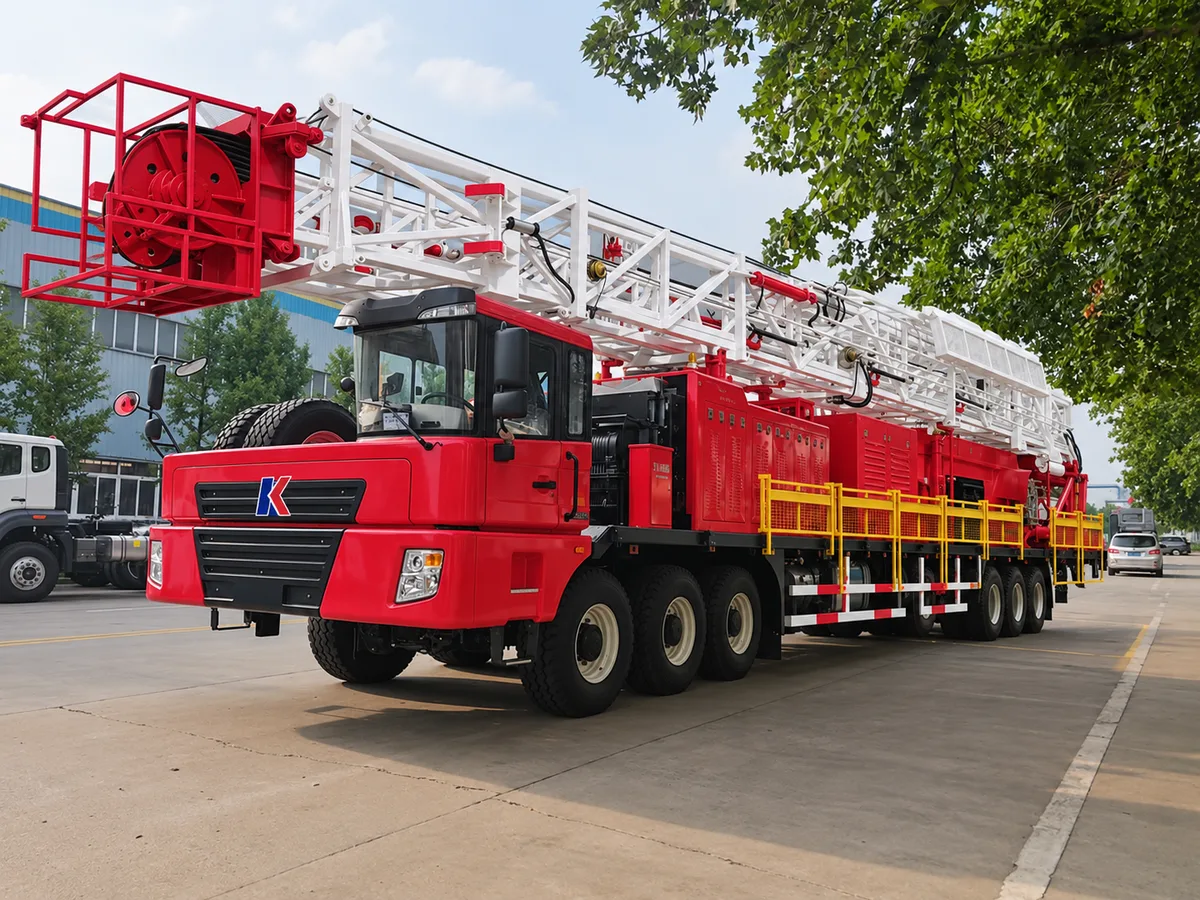
Should you buy a new or used truck-mounted workover rig?
Neither route is better by default. Decide on five points, in this order:
- Well-program fit. Does the rig’s documented capacity, with its stated tubular basis and load rating term, cover the planned work with a margin your engineers accept?
- Verifiable condition. Can the load-bearing structure, hoisting system, power train and carrier be shown to be in serviceable condition, with records rather than appearance?
- Documentation chain. Will you receive the drawings, load ratings, inspection reports, test records and manuals your operator, insurer or authority will ask for?
- Schedule. When do you actually need the rig on location, including inspection, any repair work, export documents and transport?
- Lifecycle cost. What will the rig cost to own and keep working over the contract or fleet plan, not only on the day it is bought?
If a used or refurbished unit passes all five, it can be a sound choice. If it fails the first or the third, a lower purchase price rarely makes up for it. Buyers comparing workover rigs for sale often start with price lists and model names; the comparison is more useful when it starts with these five questions.
New-build, used and refurbished: what does each route actually deliver?
The three labels describe different supply conditions, and no single industry definition fixes them. Ask the seller to state the condition in writing.
- New-build. The rig is manufactured to an agreed configuration for your order. The workover rig manufacturer is normally responsible for the design, the build records, the pre-shipment tests and the handover documents, as defined in the contract.
- Used (as-is). The rig is offered in its present condition. Any inspection, repair or testing before shipment has to be agreed separately, and you carry most of the condition risk.
- Refurbished. Defined work has been carried out on a used rig, such as inspection, repair, component replacement and testing. The value of the label depends entirely on the written work scope and the records that prove it was done.
The used and refurbished workover rig inspection checklist explains what a refurbishment scope should list. This guide focuses on the step before that: which route to choose.
When does a new-build workover rig make more sense?
A new-build rig usually makes more sense when one or more of the following applies:
- You need a specific capacity or carrier configuration. If the well program calls for a particular load basis, mast height or racking arrangement, or the roads call for a particular axle and drive layout, a new-build lets you specify it rather than adapt to what happens to be available.
- The destination has defined requirements. Some operators and countries set requirements for documentation, design references, engine emissions, electrical equipment in hazardous areas, well-control equipment, lighting or road registration. A new-build can be designed for them from the start; an existing rig may need changes, or may not meet them at all.
- You need a complete documentation set. Drawings, load charts, an inspection and test plan, factory acceptance test (FAT) records and manuals are easiest to obtain when the rig is built for your order.
- The rig will work for many years. For a multi-year program or a fleet that will be maintained in-house, the value of a known design, known build records and a consistent spare parts list grows with every year of service.
- You want a warranty from the party that built the rig. Warranty terms vary by supplier and contract; on a new-build, the manufacturer that built the rig is usually the party asked to provide one.
The trade-off is time and initial cost. A new-build has to be engineered, built and tested before it ships, and the schedule depends on the configuration and the supplier’s workload. Ask each supplier for a dated schedule for your configuration rather than relying on a general figure.
When comparing suppliers for a new-build, use how to evaluate a workover rig manufacturer in China to check engineering, quality records and FAT scope. To compare current models, see the range of new-build truck-mounted workover rigs for sale on the model comparison page.
When can a used or refurbished rig be the better choice?
A used or refurbished rig can be the better choice when:
- The contract is short or the start date is close. A suitable unit that already exists may reach location sooner, provided inspection, repair and export steps are planned realistically.
- A traceable unit already matches the duty. The rig’s documented capacity, mast and carrier fit the well program without major changes.
- The budget is fixed and the risk is understood. The lower purchase price is weighed against the inspection, repair, transport and downtime risk, and the result still works.
- Condition evidence is acceptable. The seller can provide identity records, service history and recent inspection reports, and agrees to a witnessed test before shipment.
Availability is unit-specific. A listing for a used workover rig for sale describes one asset at one point in time, and its identity, condition and included equipment have to be confirmed for that unit. If you are considering used and refurbished workover rigs, start by stating your duty, destination and acceptable condition, and ask the seller to confirm whether a matching unit exists.
A used rig is a weak choice when its rating documents are missing, when it needs a different carrier or mast to suit your work, or when the destination’s import rules for used equipment are unclear. Some importing countries restrict used machinery, for example through age limits, import approvals or mandatory pre-shipment inspection. Rules change, so confirm the current requirements with the importing country’s customs or trade authority, through your import agent, before you commit.
How do capacity and configuration risks differ?
On a new-build, capacity risk is mainly a design and specification question: does the quoted configuration cover the duty? On a used rig, there is a second question: does the rig still deliver the capacity it was built for?
Nameplate rating vs current condition
A mast nameplate or original specification sheet states the capacity of the structure as designed. It does not prove the present condition of that structure. Corrosion, impact damage, fatigue cracking, worn pins and pin holes in the mast and substructure, worn sheaves in the crown and traveling blocks, and repairs not carried out to an approved procedure can all reduce the load the rig should be allowed to carry. Where condition is in doubt, a qualified inspector may recommend repair or further examination, and the original manufacturer or a qualified engineer should confirm in writing whether the original rating still applies or must be reduced before the rig returns to service.
API RP 4G (Operation, Inspection, Maintenance, and Repair of Drilling and Well Servicing Structures) is an API recommended practice that is widely used as a reference for mast and substructure inspection. It is guidance, not a certification, and it supplements rather than replaces the manufacturer’s instructions. It describes inspection categories that range from visual observation during operations to a detailed inspection that includes nondestructive examination of critical areas. If an inspection report refers to API RP 4G, check which inspection category and procedure it states, who carried it out and when, and read the findings. Naming a standard in a sales offer does not show that the rig was inspected to it; only the inspection report can show that.
Two further points apply to load figures on any route. First, keep the rating term attached to every number: rated, maximum and static loads are different terms and are not interchangeable. The workover rig hook load explainer covers the difference. Second, keep the tubular basis attached to every depth figure. A depth rating is stated for a specific tubing or drill pipe size and does not stand alone. For mast height and tubing racking, see workover rig mast height and racking capacity.
Reconfiguration limits
It is tempting to buy a used rig and change what does not fit. In practice, changing a used rig’s carrier, mast or main power train is often impractical. Major changes affect the structural design, axle loads, transport mass, controls and documentation, and the result may need a fresh engineering assessment and new records. Smaller additions, such as lighting, guarding, instrumentation, heaters or extra air filtration, are more often feasible, but they still need to be defined, quoted and tested. A full cold-climate or desert package is a larger change: cooling capacity, cold starting, fluids, seals, enclosures and the low-temperature suitability of the structure need an engineering assessment, and some of these cannot be changed on an existing rig.
If a used unit only fits after major changes, compare it with a new-build of the configuration you actually need. Ask any seller who proposes reconfiguration for an engineering assessment of the change, who will perform the work, and which documents will be updated.
How do documentation and acceptance differ?
The documents differ because the evidence differs. A new-build produces records as it is built. A used rig has whatever records survived its previous ownership, plus any new inspection done before sale.
| Document or record | New-build | Used or refurbished |
|---|---|---|
| Identity | Nameplate and serial data issued for your order | Nameplate, serial and identity records that match the physical unit |
| Design and ratings | Specification sheet, general arrangement drawings and load ratings for the quoted configuration | Original specification and rating documents, if available; any later rating changes |
| Build and quality records | Inspection and test plan, material and welding records as agreed in the contract | Service history, repair records and any records of earlier modifications |
| Structural inspection | Manufacturer’s inspection records before shipment | Recent mast and substructure inspection report, including any nondestructive examination (NDE) records, with method, inspector, date and findings |
| Wire rope | Drilling line and sand line certificates as supplied | Wire rope certificates, if available, and the date of last replacement |
| Hoisting equipment | Rating and inspection records for the crown block, traveling block and hook | Rating plates, inspection records and any repairs for the crown block, traveling block and hook |
| Well-control equipment (if supplied) | Pressure-test records and certificates for the supplied BOP and well-control items | Pressure-test records and certificates for any BOP or well-control items included in the sale |
| Engine and transmission | Make, model and serial numbers; build test records where provided by the component maker | Make, model and serial numbers, hour meter readings cross-checked with service records, and the repair history |
| Work done | Not applicable | Written refurbishment scope: items inspected, repaired or replaced, and parts used |
| Testing | FAT records, with the scope agreed in the order | Witnessed function test after any repair work, with a signed record; a load test or load-indicator check only where agreed and to a stated procedure |
| Manuals and parts | Operating and maintenance manuals, parts books | Available manuals and parts information; confirmation that key parts can still be obtained |
| Carrier registration and ownership | Vehicle documents for registration in the destination, as agreed | Registration or title documents, proof of ownership and any deregistration or export papers for the carrier |
For a used or refurbished rig, four records matter most before you commit:
- identity and serial records that match the unit you will inspect;
- service and repair history for the mast, drawworks, brakes and power train, including engine and transmission hours;
- a recent structural inspection report for the mast and substructure;
- a witnessed test run after any repair or refurbishment work.
The full step-by-step inspection, from the mast and drawworks to the carrier and test run, is in the used workover rig inspection checklist. For a new-build, the equivalent records are the inspection and test plan, FAT records and the handover document list agreed in the contract.

How do schedule, total cost and lifecycle risk compare?
Purchase price is only one line in the comparison. The cost drivers below apply to every route, but they carry different weight.
| Cost or risk driver | New-build | Used (as-is) | Refurbished |
|---|---|---|---|
| Purchase price | Usually the highest initial outlay for a given configuration | Usually the lowest initial outlay | Usually between the two; a large work scope can bring it close to new-build |
| Inspection before purchase | FAT witness costs, if attended | Inspection travel and third-party inspection fees | Inspection of the work done, plus witness costs |
| Repair and refurbishment | Not expected before delivery | Unknown until inspected; may be significant | Defined in the work scope; check what is excluded |
| Schedule risk | Engineering, build and test time | Shorter if the unit is ready; longer if repairs are found | Depends on work scope and parts supply |
| Spare parts | Current parts list from the build | Parts for older components may be harder to obtain | Depends on which components were replaced |
| Downtime risk in service | Lower, if the design suits the duty | Higher, until condition is proven in operation | Depends on the quality and scope of the work |
| Transport and export | Planned for the new configuration | Depends on the unit’s present location and condition | As for used, plus the work location |
| Residual value | Known build date and records | Depends on age, records and condition | Depends on records of the work done |
Three points often decide the outcome. First, inspection is a real cost on the used route and should be budgeted before any unit is shortlisted. Second, on an as-is purchase, repairs found after delivery are normally the buyer’s cost unless the contract allocates them otherwise. Third, parts support for older engines, transmissions and control systems should be confirmed with the component makers or their dealers, not assumed.
Decision matrix: new-build vs used vs refurbished
Use the matrix to compare the three routes for your project. The last column lists what to check whichever route you choose.
| Factor | New-build | Used (as-is) | Refurbished | What to check |
|---|---|---|---|---|
| Well-program fit | Specified to the duty | Fixed by the existing unit | Fixed, with limited changes | Documented capacity with its tubular basis and rating term against the well program |
| Configuration flexibility | High: carrier, mast and power package chosen for the order | Low: what exists | Low to medium: minor changes are often feasible | Engineering assessment of any proposed change |
| Condition certainty | Known from build and test records | Low until inspected | Medium, if the work scope and records are complete | Structural inspection report and a witnessed test run |
| Documentation | Full set issued for the order | Whatever survived, plus new inspection | Existing records plus records of the work done | Identity, rating, inspection and test records that match the unit |
| Warranty | Usually negotiated with the manufacturer; terms set by contract | Often limited or none | Depends on the seller and the work scope | Written warranty terms: scope, duration and exclusions |
| Schedule | Engineering, build and test time | Potentially short if no repairs are needed | Depends on work scope | Dated schedule including inspection, repairs, export and transport |
| Lifecycle cost drivers | Higher purchase price, lower early repair risk | Lower purchase price, higher unknowns | Balanced, if the work is documented | Inspection, repair, parts, downtime and transport costs |
| Acceptance method | FAT to an agreed scope | Pre-purchase inspection and function test | Inspection of the work done plus a function test | Who witnesses, what is tested, and the signed record |
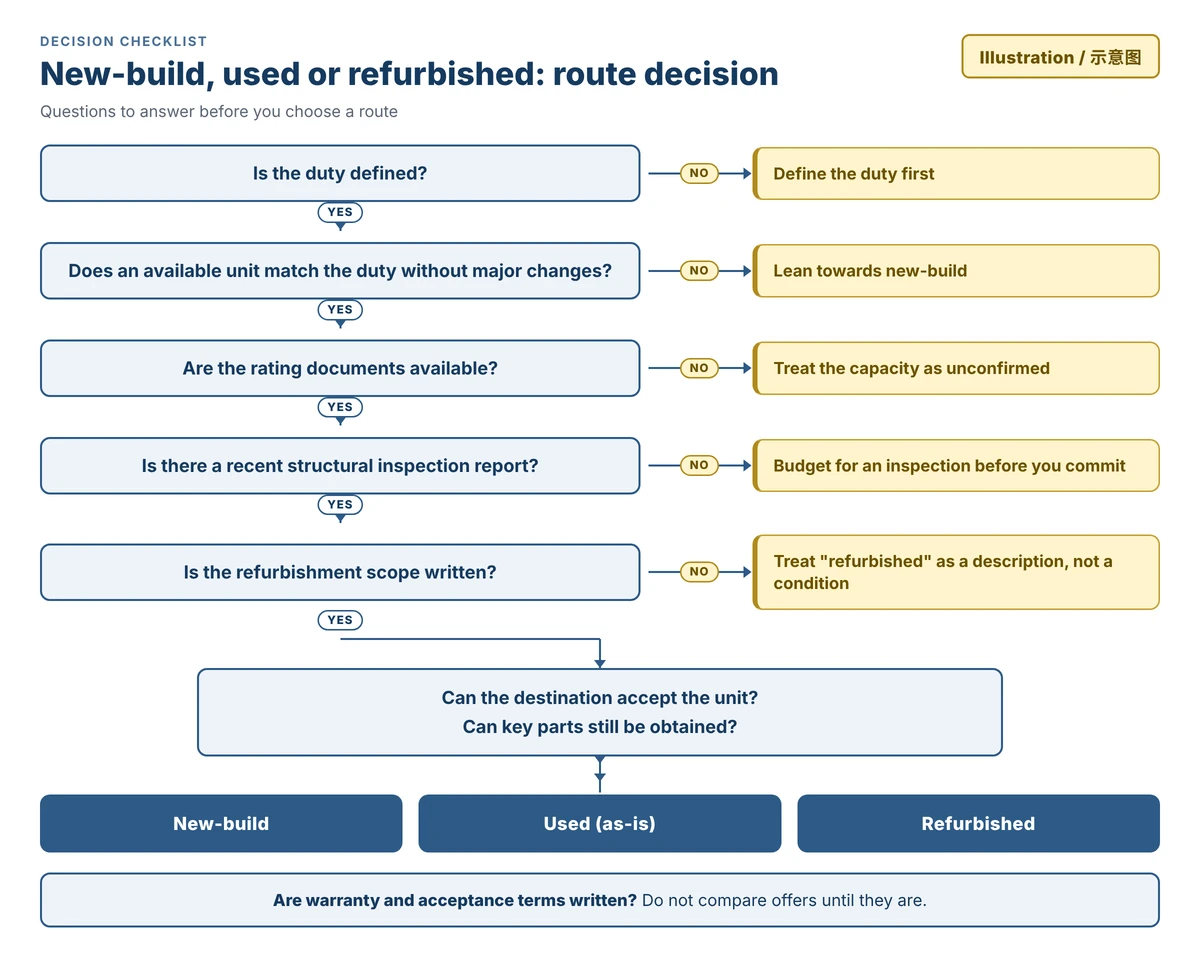
Decision checklist: questions to answer before you choose a route
| Buyer question | What to check | If the answer is no |
|---|---|---|
| Is the duty defined? | Well depth, tubular sizes and weights, peak hook load with allowances, mast and racking needs, site and transport limits | Define the duty first; a route decision is premature |
| Does an available unit match the duty without major changes? | Documented capacity, mast and carrier against the duty | Lean towards new-build |
| Are the rating documents available for the used unit? | Original specification, nameplate data and any later rating changes | Treat the capacity as unconfirmed |
| Is there a recent structural inspection report? | Method, inspector, date, findings and any repairs | Budget for an inspection before you commit |
| Is the refurbishment scope written? | Items inspected, repaired or replaced; parts used; tests done | Treat “refurbished” as a description, not a condition |
| Can the destination accept the unit? | Import rules for used equipment, emissions, registration and operator requirements | Confirm the current rules with the importing country’s customs or trade authority before shortlisting |
| Can key parts still be obtained? | Engine, transmission, brake and control parts from makers or dealers | Factor parts risk into lifecycle cost |
| Does the schedule include all steps? | Inspection, repairs, export documents and transport | Re-plan before comparing offers |
| Are warranty and acceptance terms written? | Warranty scope and duration; acceptance test and witness | Do not compare offers until they are |
What should you prepare before requesting a quote for either route?
The same core data serves both routes, and sending it to every seller makes the offers comparable:
- the well program: depth range, tubular sizes and weights, and the type of work;
- the required hook load basis, including allowances agreed by your engineers;
- mast and racking needs;
- site access, road limits and the destination country;
- climate and operating environment;
- the documents and tests you require at handover;
- for the used route, your acceptable age and condition, the inspection you will require and whether you will accept refurbishment work.
The workover rig quotation checklist gives the full list of information to provide with a quotation request.
How does Hubei Link handle new-build and used or refurbished inquiries?
Hubei Link Petroleum Equipment Co., Ltd. is a truck-mounted workover rig manufacturer in China. It handles the two routes separately.
New-build. The truck-mounted range covers four model classes: the XJ550, XJ650, XJ750 and XJ1000. Each model page shows its published values with their stated basis. Final model, chassis and supporting-equipment choices depend on the confirmed operating basis and engineering review. To start, request a new-build configuration with your well program and site data.
Used and refurbished. Hubei Link discusses inspection-based sourcing and refurbishment for selected workover rigs, truck-mounted units, oilfield chassis and related equipment. Availability is not fixed: every inquiry requires confirmation of the specific unit and the proposed supply condition. As the used equipment page states, it does not represent a standing inventory list, fixed delivery schedule or guaranteed configuration, and suitability for the target well program remains subject to inspection and engineering review. To find out whether a matching unit exists, ask about a used or refurbished unit with your equipment type, capacity requirement, destination, quantity, acceptable condition and inspection or refurbishment expectations.
Frequently asked questions
Is a used workover rig cheaper than a new one over its working life?
Not necessarily. A used rig usually costs less to buy, but inspection, repairs found after purchase, harder-to-obtain parts and downtime can narrow or reverse the difference. Compare the routes on inspection, repair, parts, downtime, transport and residual value, not on purchase price alone.
What is the difference between a used and a refurbished workover rig?
A used rig is offered in its present condition. A refurbished rig has had defined work carried out, such as inspection, repair, component replacement and testing. Because no single industry definition applies, ask for the written refurbishment scope and the records that show the work was done.
Can a used rig’s nameplate hook load and depth rating be relied on?
Only as a starting point. The nameplate and original specification describe the rig as designed. Present condition, earlier repairs and any rating changes must be checked through a recent structural inspection report and service records. Keep the rating term and tubular basis attached to every figure.
What documents should come with a used or refurbished workover rig?
At minimum: identity and serial records that match the unit, the original specification and rating documents if available, service and repair history, a recent mast and substructure inspection report, the written refurbishment scope if any, a signed test record, and available manuals and parts information.
When is a new-build truck-mounted workover rig the safer choice?
When the duty needs a specific capacity or carrier configuration, when the destination has defined requirements, when you need a full documentation set, or when the rig will work for many years. In these cases the certainty of a known design and build record usually outweighs the higher purchase price.
Can a used workover rig be reconfigured for a different carrier or climate?
Minor additions, such as lighting, guarding, instrumentation or heaters, are often feasible. Full cold-climate or desert packages need an engineering assessment first. Changing the carrier, mast or main power train is often impractical, because it affects the structure, axle loads, transport mass and documentation. Ask for an engineering assessment before you rely on any reconfiguration.
Does API RP 4G mean a used rig has been inspected?
No. API RP 4G is a recommended practice, not a certification scheme, for the operation, inspection, maintenance and repair of drilling and well servicing structures such as masts and substructures. Naming it in an offer does not show that the rig was inspected to it. Ask for the inspection report, which should state the inspection category, method, inspector, date and findings.
Does Hubei Link keep a list of used workover rigs available?
The used and refurbished equipment page states that it does not represent a standing inventory list, and that inventory, manufacture year, condition and refurbishment scope vary by unit and are confirmed only for a specific inquiry. Send your requirements through the used equipment inquiry form to ask whether a matching unit exists.