
There is no single list price for a truck-mounted workover rig. The cost of a new-build unit is set by the capacity class it is built to, the carrier it rides on, the power train and hoisting package, any climate or site package, the scope of supply, the documents and inspections in the contract, and the delivery terms. Two offers that look alike on the first page can differ widely once those items are lined up.
This guide is for procurement managers, tender engineers and technical managers who have to budget for a rig or compare offers from several suppliers. It explains which items move the cost, what to confirm in each offer, and how to put two quotations on the same basis. It does not publish prices, and it does not tell you how to size the rig: to define the duty first, see how to select a truck-mounted workover rig.
How much does a truck-mounted workover rig cost?
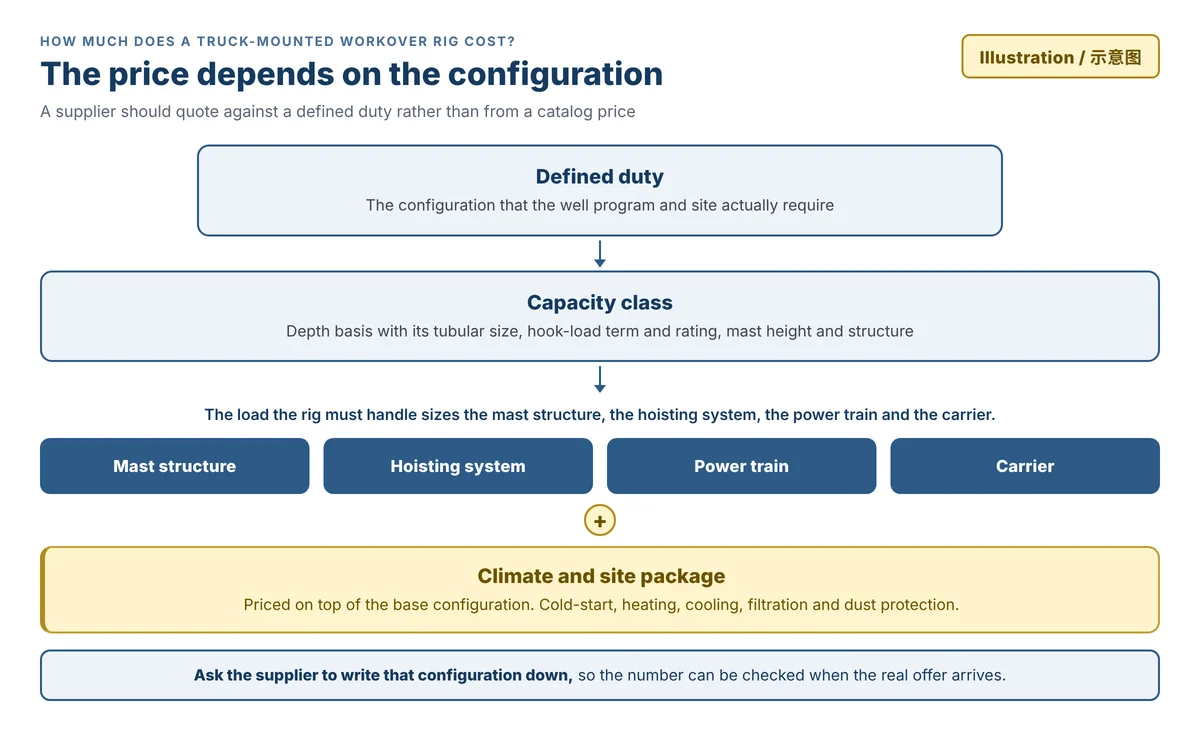
Direct answer. The price depends on the configuration that the well program and site actually require, so a supplier should quote against a defined duty rather than from a catalog price. Hubei Link’s workover rig pages do not publish prices; each offer is prepared from the buyer’s well data, site conditions and supply boundary.
Why there is no fixed figure. A workover rig is used to repair, maintain or restore existing wells. The SLB Energy Glossary entry for workover describes it as the repair or stimulation of an existing production well, and as the process of performing major maintenance or remedial treatments on a well. The equipment needed for that work changes with the depth and tubular program, the loads to be handled, the roads to the wellsite and the climate. Each of those choices is often priced as a separate item in an offer.
What to do with this. Treat any early “budget price” as an order of magnitude tied to a stated configuration. Ask the supplier to write that configuration down, so the number can be checked when the real offer arrives.
Which cost drivers matter most?
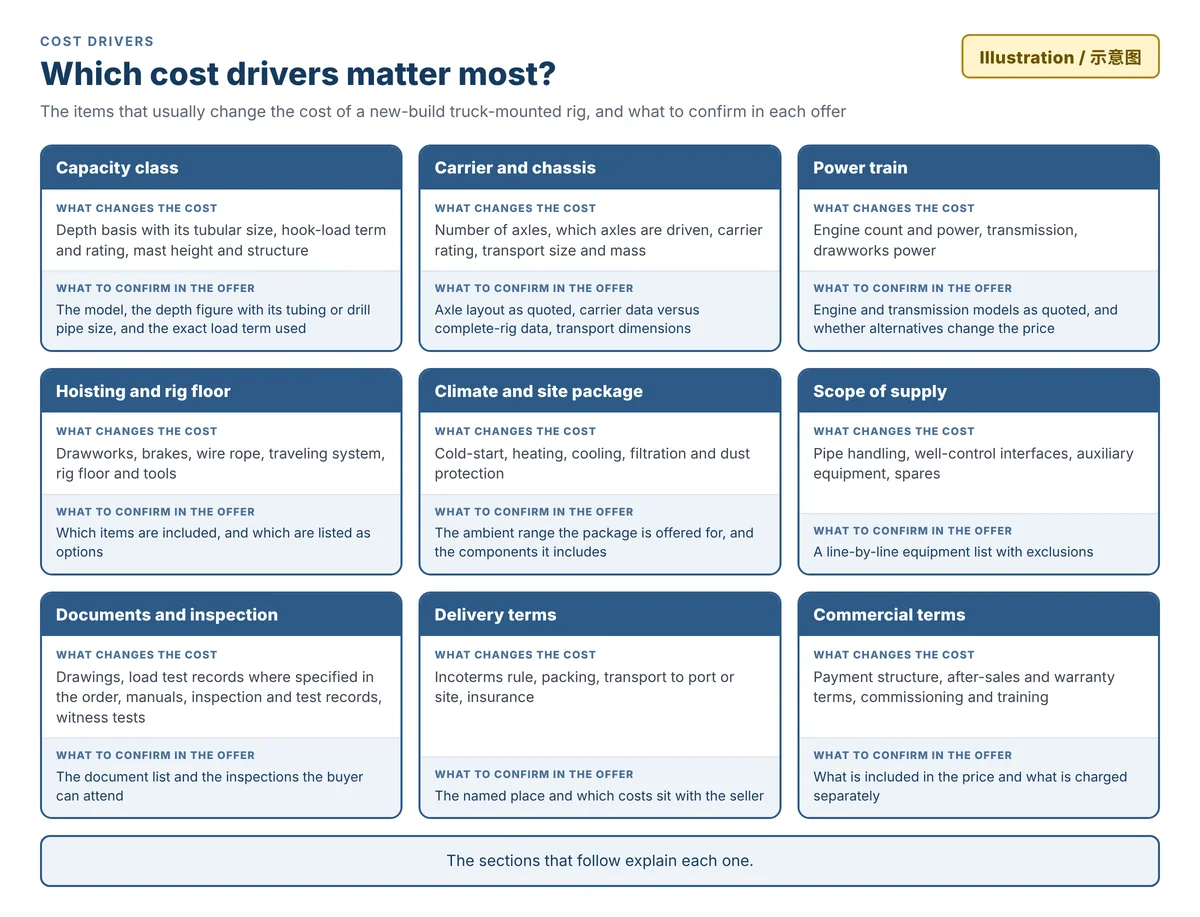
The table below summarizes the items that usually change the cost of a new-build truck-mounted rig, and what to confirm in each offer. The sections that follow explain each one.
| Cost driver | What changes the cost | What to confirm in the offer |
|---|---|---|
| Capacity class | Depth basis with its tubular size, hook-load term and rating, mast height and structure | The model, the depth figure with its tubing or drill pipe size, and the exact load term used |
| Carrier and chassis | Number of axles, which axles are driven, carrier rating, transport size and mass | Axle layout as quoted, carrier data versus complete-rig data, transport dimensions |
| Power train | Engine count and power, transmission, drawworks power | Engine and transmission models as quoted, and whether alternatives change the price |
| Hoisting and rig floor | Drawworks, brakes, wire rope, traveling system, rig floor and tools | Which items are included, and which are listed as options |
| Climate and site package | Cold-start, heating, cooling, filtration and dust protection | The ambient range the package is offered for, and the components it includes |
| Scope of supply | Pipe handling, well-control interfaces, auxiliary equipment, spares | A line-by-line equipment list with exclusions |
| Documents and inspection | Drawings, load test records where specified in the order, manuals, inspection and test records, witness tests | The document list and the inspections the buyer can attend |
| Delivery terms | Incoterms rule, packing, transport to port or site, insurance | The named place and which costs sit with the seller |
| Commercial terms | Payment structure, after-sales and warranty terms, commissioning and training | What is included in the price and what is charged separately |
How does capacity class change the cost?
Direct answer. Capacity class is one of the biggest cost drivers, because the load the rig must handle sizes the mast structure, the hoisting system, the power train and the carrier. A rig built for heavier loads generally needs a stronger mast and hoisting system, more power and a heavier carrier, often with more axles. Mast height is set by the planned stand length and racking method rather than by load alone.
Technical context. In the Hubei Link XJ range the published figures show how these items scale together. The figures below are copied from the live model pages with their stated basis. They are nominal, configuration-dependent values, not guaranteed capacities.
| Model | Published depth figure (with tubular basis) | Mast height | Carrier | Installed or engine power |
|---|---|---|---|---|
| XJ550 | 7,000 m nominal workover depth with 2-7/8 in EUE tubing | 34 m | Dedicated five-axle carrier, 10×8 or 10×10 | 550 hp or 540 hp (domestic or imported engine) |
| XJ650 | 8,500 m nominal servicing depth with 2-7/8 in EUE tubing | 35 m | Dedicated six-axle carrier, 12×8 | 700 hp |
| XJ750 | 6,500 m workover depth with 3-1/2 in drill pipe | 38 m | Dedicated seven-axle carrier, 14×8 | 540 hp × 2 or 550 hp × 2 |
| XJ1000 | 7,500 m workover depth with 3-1/2 in drill pipe | 39.3 m | Dedicated seven-axle carrier, 14×10 as listed, 14×8 option | 630 hp × 2 |
Conditions and limitations. The depth figures are not on one common basis. The terms differ too: the XJ650 figure is a nominal servicing depth, while the others are workover depths. The XJ550 and XJ650 figures are stated with 2-7/8 in EUE tubing; the XJ750 and XJ1000 figures are stated with 3-1/2 in drill pipe. A larger depth figure stated with a smaller, lighter string does not mean a larger rig, so compare models against your own tubular schedule, not against the headline depth. Load ratings also use different terms: the XJ750 is published with an 1800 kN maximum hook load and the XJ1000 with a 2250 kN maximum hook load, and those maximum figures should not be read as interchangeable with a rated hook load or a mast static load. The workover rig hook load explainer sets out how the terms differ.
Procurement consequence. Buying one class above the duty adds cost in every block at once: mast, drawworks, power and carrier. Buying one class below the required load basis can leave the rig short of the duty and add operational risk. Fix the load basis from the heaviest string you plan to handle, with the margin your engineers require, and then choose the smallest class that covers it. The workover rig mast height and racking capacity guide covers the mast side of the same decision.
Source. Model figures: the Hubei Link XJ550, XJ650, XJ750 and XJ1000 product pages, read on 24 November 2026.
How do the carrier and chassis affect the cost?
Direct answer. The carrier is a major cost block of its own. More axles, more driven axles and a higher carrier rating each add components, and the transport size and mass of the finished rig then set the cost of moving it, both at export and in the field.
Technical context. In the XJ range the axle count rises with the capacity class, from five axles on the XJ550 to six on the XJ650 and seven on the XJ750 and XJ1000. Two models are published with a choice of drive layout: the XJ550 with 10×8 or 10×10, and the XJ1000 with 14×10 as listed and 14×8 as an option. On the XJ550 page, the 10×8 layout has axles 1 and 2 as steering drive axles, axle 3 as a non-driven load-bearing axle and axles 4 and 5 as driven axles, while the 10×10 layout drives all five axles. Where two layouts exist, ask for each to be priced as a separate line, so the cost of the extra driven axle is visible and can be weighed against the terrain.
Transport size and mass. The larger rigs may be treated as oversize or overweight loads on many public roads. The XJ750 page lists transport dimensions of 22.6 × 3.3 × 4.64 m and a transport weight of 76,000 kg. The XJ1000 page lists transport dimensions of 21.65 × 3.3 × 4.9 m and a rig weight of 82,000 kg. These figures do not show that a rig is road-legal on a given route. They do show why sea freight, port handling, escort vehicles, permits and route surveys can become a significant part of the landed cost.
Conditions and limitations. For the XJ550 and XJ650, the carrier dimensions and gross vehicle weights published on the model pages describe the carrier, not the complete rig. Ask for the complete-rig transport figures of the configuration you are being offered.
Procurement consequence. Ask whether the offer includes the carrier as a dedicated oilfield chassis or as a commercial truck chassis, which axles are driven, and the transport dimensions and mass of the rig as quoted. The high-mobility oilfield chassis planning page explains how terrain and road limits feed into the axle choice.
Source. Hubei Link XJ550, XJ650, XJ750 and XJ1000 product pages, read on 24 November 2026.
How do the power train and hoisting package affect the cost?
Direct answer. Engine count and power, the transmission, and the drawworks power are expensive components, and the brands chosen for them can change the price of the same rig class.
Technical context. The two larger XJ models are published with twin engines: 540 hp × 2 or 550 hp × 2 on the XJ750, and 630 hp × 2 on the XJ1000. The XJ750 page lists a drawworks rated power of 750 hp, and the XJ1000 page a drawworks power of 1000 hp. The XJ750 page also lists additional engine and transmission options in its powertrain and vehicle ratings section. When a page shows options, the specific pairing is fixed in the quotation, not by the page.
Conditions and limitations. Engine and transmission brands affect more than the purchase price. They also affect parts availability and service support in the country of operation, so check the dealer and service network for each brand there.
Procurement consequence. Ask the supplier to name the engine and transmission models quoted, and to price any alternative you are considering as a separate line. Ask what is included in the hoisting package: drawworks, brakes, wire rope, traveling block and hook, and rig floor tools. If two offers name different brands, compare the parts and service route in your country, not only the line price.
How do climate packages and site conditions change the cost?
Direct answer. A rig specified for extreme cold or for hot, dusty desert sites needs extra equipment, and that equipment is priced on top of the base configuration.
Technical context. Cold-climate packages can include cold-start aids, heating for engines, hydraulics and cabins, and low-temperature materials where the design calls for them. Desert packages can include larger cooling capacity, heavy-duty air filtration and dust protection for electrical cabinets. The scope depends on the ambient range the buyer specifies. Any climate package is subject to engineering confirmation against the stated ambient range.
Conditions and limitations. A climate package is only meaningful against a stated ambient range and duty. Ask the supplier which temperature range and conditions the package is offered for, and which components it contains.
Procurement consequence. State the site’s minimum and maximum ambient temperatures, dust or sand exposure and altitude in the inquiry. The desert operation workover rig configuration checklist and the cold climate workover rig solutions page list the items to cover.
What should the scope of supply include?
Direct answer. Many price differences between offers come from what is, and is not, included. A low price that excludes pipe handling tools, spare parts or documentation can end up costing more than a complete offer.
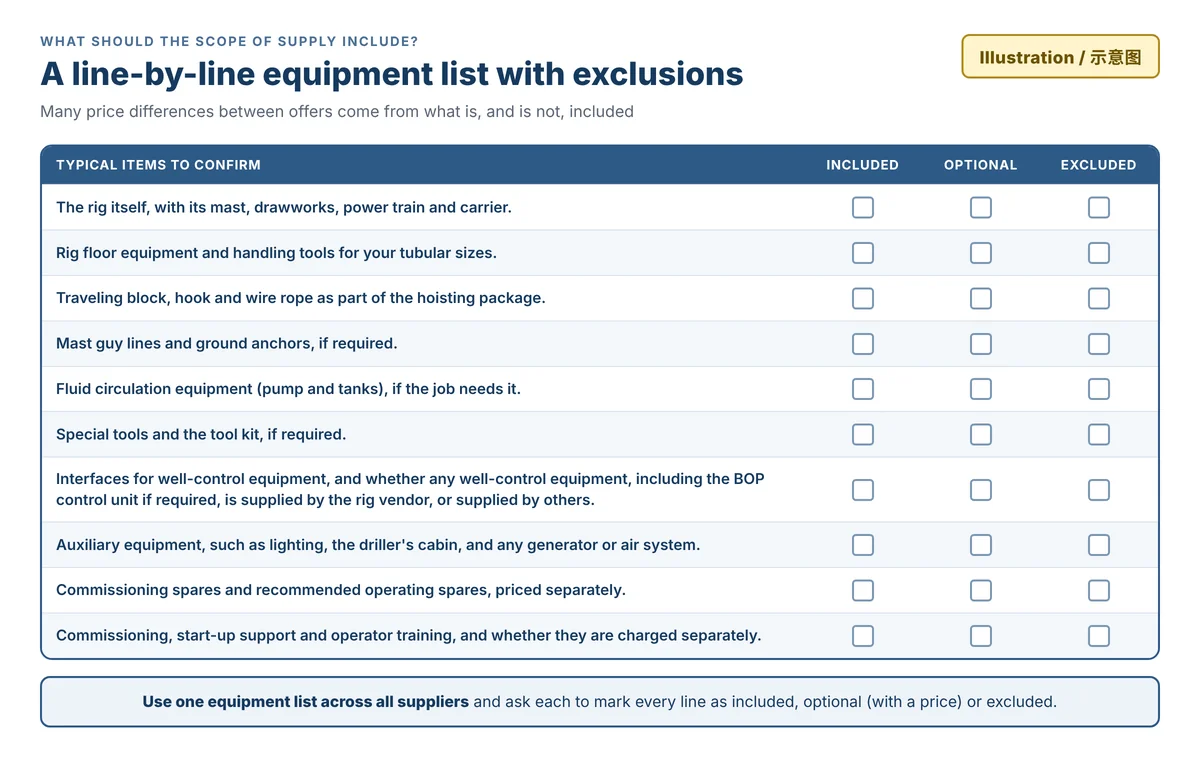
What to check. Ask each supplier for a line-by-line equipment list with clear exclusions. Typical items to confirm:
- The rig itself, with its mast, drawworks, power train and carrier.
- Rig floor equipment and handling tools for your tubular sizes.
- Traveling block, hook and wire rope as part of the hoisting package.
- Mast guy lines and ground anchors, if required.
- Fluid circulation equipment (pump and tanks), if the job needs it.
- Special tools and the tool kit, if required.
- Interfaces for well-control equipment, and whether any well-control equipment, including the BOP control unit if required, is supplied by the rig vendor, or supplied by others.
- Auxiliary equipment, such as lighting, the driller’s cabin, and any generator or air system.
- Commissioning spares and recommended operating spares, priced separately.
- Commissioning, start-up support and operator training, and whether they are charged separately.
Procurement consequence. Use one equipment list across all suppliers and ask each to mark every line as included, optional (with a price) or excluded. The workover rig quotation checklist explains how to define the supply boundary in the inquiry itself.
How do delivery terms, inspection and documents affect the landed cost?
Direct answer. An ex-works price and a price delivered to your port are different numbers for the same rig. The delivery rule, export packing, inspection visits and the document set all add cost, and suppliers do not always include them in the same way.
Delivery terms. The International Chamber of Commerce publishes the Incoterms® rules, which clarify the tasks, costs and risks involved in delivering goods from sellers to buyers. Ask each supplier to quote under the same Incoterms rule and the same named place. If one offer is quoted on a different basis, add the freight, insurance and handling costs before you compare.
Import costs. Under every Incoterms rule except DDP, import clearance, import duties and taxes in the destination country are the buyer’s responsibility. Destination port and terminal charges depend on the rule and the carriage contract, so confirm which party pays them. Check these costs with your customs broker or import agent before you commit; unless the offer is DDP, they are not included in the supplier’s price.
Inspection and documents. Witness inspections, third-party inspection and the depth of the document package affect cost and schedule. Ask for the document list (drawings, load test records where specified in the order, manuals, inspection and test records) and for the inspection points you or your inspector can attend. If your operator or project specification calls for particular standards, ask how the supplier evidences compliance for this rig. A reference to a standard is not a certificate. The guide on how to evaluate a workover rig manufacturer in China explains which quality and inspection records to request.
Procurement consequence. Compare landed cost, not line price. Add every cost that one offer includes and another leaves out, for the same delivery point.
How should you compare two workover rig quotations?
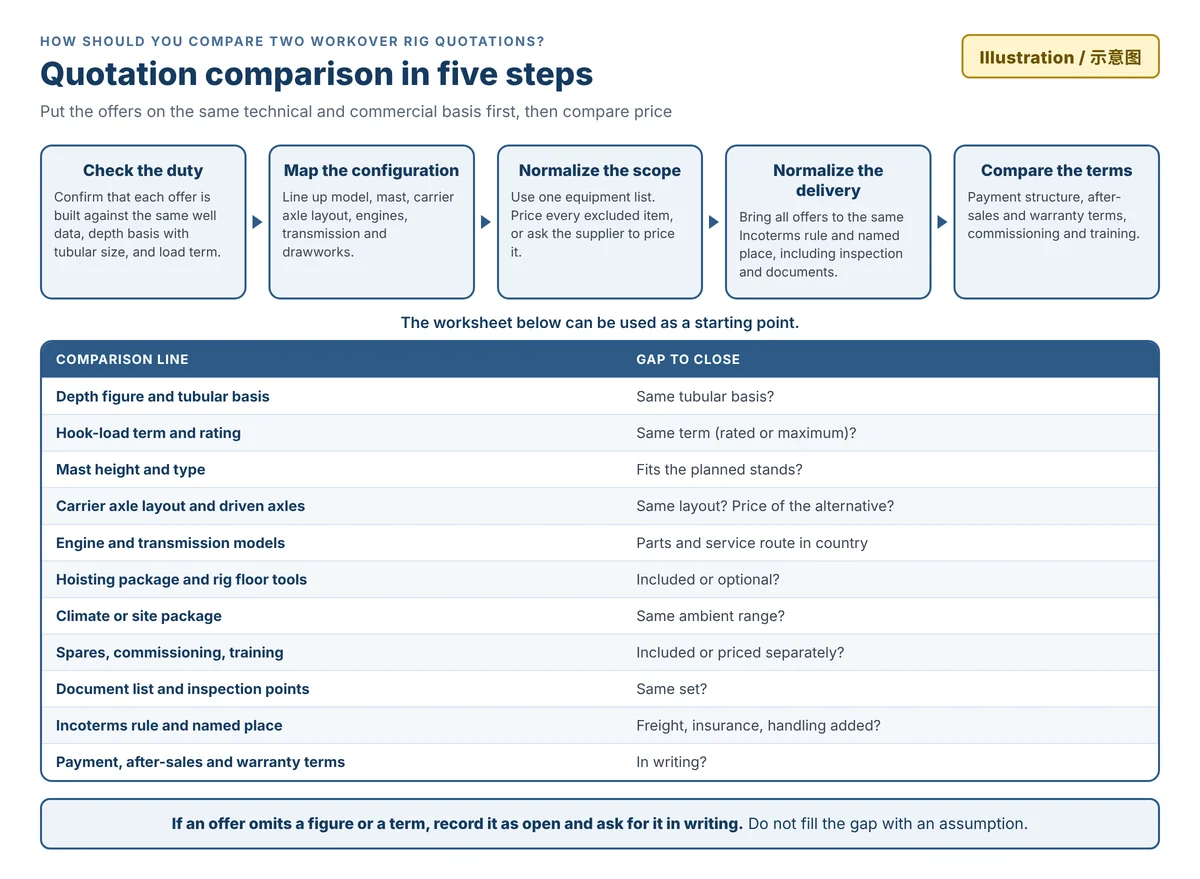
Direct answer. Put the offers on the same technical and commercial basis first, then compare price. Five steps do most of the work.
- Check the duty. Confirm that each offer is built against the same well data, depth basis with tubular size, and load term. An offer quoted to a different load term or tubular basis is a different rig.
- Map the configuration. Line up model, mast, carrier axle layout, engines, transmission and drawworks. Note every difference.
- Normalize the scope. Use one equipment list. Price every excluded item, or ask the supplier to price it.
- Normalize the delivery. Bring all offers to the same Incoterms rule and named place, including inspection and documents.
- Compare the terms. Payment structure, after-sales and warranty terms, commissioning and training. Record what each offer includes in writing.
The worksheet below can be used as a starting point.
| Comparison line | Offer A | Offer B | Gap to close |
|---|---|---|---|
| Depth figure and tubular basis | Same tubular basis? | ||
| Hook-load term and rating | Same term (rated or maximum)? | ||
| Mast height and type | Fits the planned stands? | ||
| Carrier axle layout and driven axles | Same layout? Price of the alternative? | ||
| Engine and transmission models | Parts and service route in country | ||
| Hoisting package and rig floor tools | Included or optional? | ||
| Climate or site package | Same ambient range? | ||
| Spares, commissioning, training | Included or priced separately? | ||
| Document list and inspection points | Same set? | ||
| Incoterms rule and named place | Freight, insurance, handling added? | ||
| Payment, after-sales and warranty terms | In writing? |
Conditions and limitations. If an offer omits a figure or a term, record it as open and ask for it in writing. Do not fill the gap with an assumption.
Is a used workover rig cheaper overall?
Direct answer. A used rig usually costs less to buy, but its total cost depends on condition, the repairs found during inspection, the remaining life of major components, and whether its documented capacity fits the job.
The guide on new vs used truck-mounted workover rigs compares the three routes in detail. If you are looking for a used workover rig for sale, the used and refurbished workover equipment page explains how Hubei Link handles used and refurbished inquiries; availability is confirmed per inquiry.
What information gets you an accurate quotation faster?
Direct answer. The faster a supplier can fix the configuration, the faster and more accurate the offer. Send the well program, tubular schedule, heaviest expected load, site access and transport limits, climate, required documents and the delivery point in the first inquiry.
The workover rig quotation checklist gives a ready-to-fill list. For matching the rig to the planned operation, see workover rig solutions by well program.
How does Hubei Link quote the XJ range?
Hubei Link Petroleum Equipment Co., Ltd. is a truck-mounted workover rig manufacturer in China. The XJ range covers the XJ550, XJ650, XJ750 and XJ1000. Each model page lists its published values with the stated tubular basis and load term. Final model, chassis and supporting equipment are confirmed against the buyer’s operating basis in the quotation.
To compare the models side by side, see the range of truck-mounted workover rigs for sale. To start an offer, request a workover rig configuration with your well data, or use the inquiry form on the model page you are considering, for example the XJ750 project inquiry.
Frequently asked questions
Does Hubei Link publish a price list for its workover rigs?
No. The price depends on the configuration, scope of supply and delivery terms, so each offer is prepared from the buyer’s well data and site conditions. Send the details through the inquiry form to receive a configuration-based offer.
Why can two quotations for the same rig class differ so much?
Usually because they are not on the same basis. Check the depth figure and its tubular size, the hook-load term, the carrier axle layout, the engine and transmission models, the scope of supply, the documents and the delivery terms. Once those are aligned, the remaining difference is easier to judge.
Does a higher depth figure always mean a more expensive rig?
Not necessarily. Depth figures are stated with a tubular basis, and different bases are not directly comparable. The XJ650 is published at 8,500 m nominal servicing depth with 2-7/8 in EUE tubing, while the XJ750 is published at 6,500 m workover depth with 3-1/2 in drill pipe. Compare rigs against your own tubular schedule and load basis.
Is a 10×10 carrier more expensive than a 10×8 carrier?
The two layouts differ in which axles are driven, so the drive components are not the same. Ask for each layout to be priced as a separate line, and choose based on the terrain and access to your wellsites.
What do Incoterms change in a workover rig quotation?
The Incoterms rule sets which party carries the tasks, costs and risks at each stage of delivery. Ask every supplier to quote under the same rule and named place, so freight, insurance and handling are treated the same way in each offer.
Should spare parts be included in the main price?
Ask for commissioning spares and recommended operating spares to be listed and priced separately. That way you can compare them line by line, and decide how many to buy based on your service location and fleet.
How do I request a quotation for an XJ model?
Use the inquiry form on the workover rigs page or on the relevant model page. Include the well program, tubular schedule, expected loads, site and transport limits, climate, required documents and delivery point.