
Workover Rig Solutions
Desert Workover Rig Solutions for Middle East Oilfields
Desert workover rig solutions must be selected for both the well program and the environment in which the equipment will operate. Well depth, tubular size and hook load determine the lifting system, while heat, dust, loose ground, long mobilization routes, fuel quality and limited maintenance access shape the chassis and supporting package.
Hubei Link Petroleum Equipment Co., Ltd. offers a solution scope covering truck-mounted workover rigs, oilfield chassis, solid-control systems, auxiliary equipment and new, refurbished or used equipment options. The final configuration depends on the confirmed well program and desert operating conditions.
Send us your well depth, tubular size, operating country and terrain conditions.
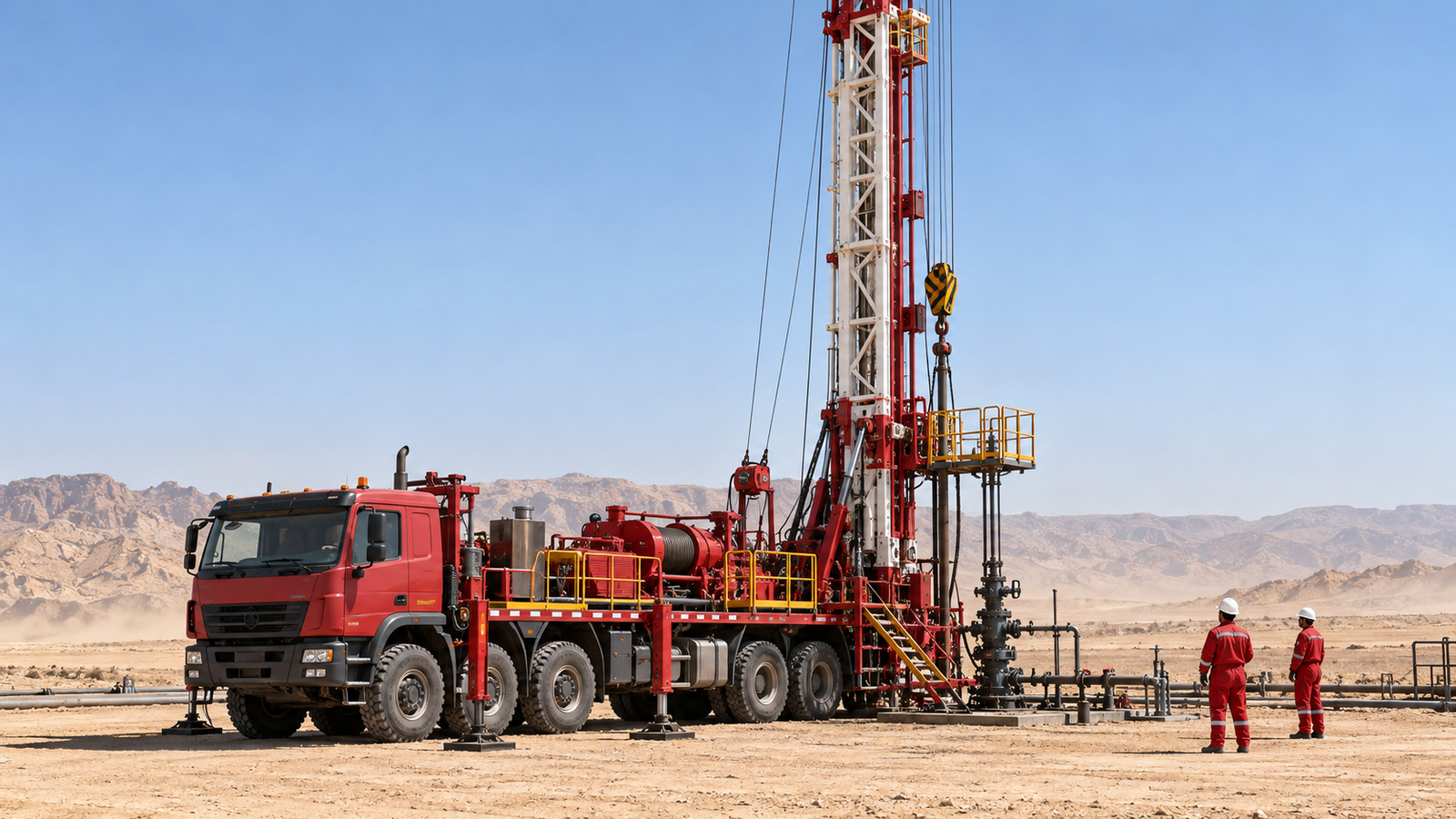
Why Desert Workover Operations Need a Complete Solution
A standard rig specification does not automatically establish suitability for a desert oilfield. High ambient temperatures increase cooling demand on engines, transmissions and hydraulic systems. Fine dust and sand affect air intake, electrical equipment, moving components and service intervals. Remote locations can also make fuel quality, spare-parts planning and field maintenance as important as nominal rig capacity.
The solution should connect four decisions:
- The workover rig must match the tubular program and calculated load case.
- The mast, traveling system, drawworks and brakes must operate as one lifting system.
- The chassis must match the total mass, terrain and transport route.
- The environmental and support package must match the temperature, dust, fuel and maintenance conditions.
Key Engineering Requirements
Well and Lifting Requirements
Begin with the planned operation, well depth and tubular specification. Tubing or drill-pipe outside diameter, grade, connection, unit weight and string length all affect the hook-load calculation.
The load case should also include tools, fluids, buoyancy, expected overpull, dynamic allowance and the project engineering margin. Rated hook load, maximum hook load and mast static load should remain separate throughout the comparison.
Heat, Dust and Fuel Conditions
A desert configuration should be based on the stated maximum ambient temperature, dust and sand exposure, operating hours and maintenance intervals. The review should cover cooling capacity, air filtration, fuel and water separation, electrical sealing, hydraulic oil, lubricants, hoses, seals and battery performance.
For the evidence and acceptance questions behind that environmental specification, see the desert operation workover rig configuration checklist.
Local diesel quality and sulfur content should be confirmed before selecting the engine and fuel-treatment arrangement. Component availability and emissions configuration may vary by destination and should be confirmed during the technical proposal.
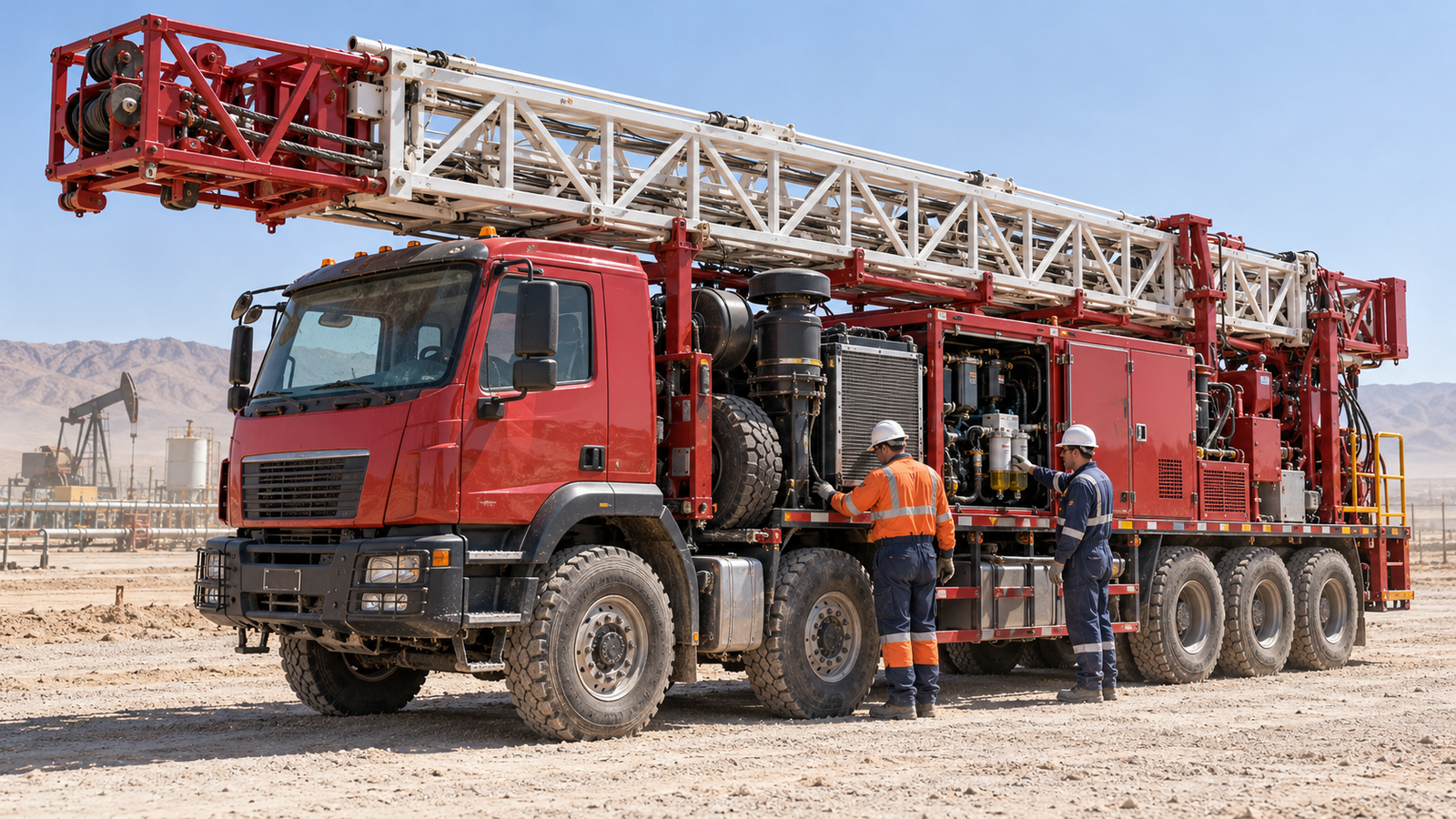
Terrain, Roads and Remote Support
Desert mobility cannot be judged from drive notation alone. Loose sand, compacted desert roads, gravel access tracks and paved highways create different requirements for traction, tires, ground pressure, steering, braking and vehicle recovery.
The route study should identify road width, bridge and axle-load restrictions, gradients, turning space, gate dimensions and maximum permitted transport height, width, length and mass. Remote-site planning should also consider fuel range, filters, tires, lubricants, special tools and technician availability.
Desert Workover Rig Selection Logic
- Define the well program. Confirm workover depth, tubular dimensions, string data, tools and expected operations.
- Calculate the lifting requirement. Determine the working load and credible maximum load case, including overpull and project margin.
- Select the rig class. Compare the required load with rated hook load, maximum hook load, mast capacity, traveling system and drawworks performance.
- Select the chassis. Match axle configuration, traction, steering, braking and tire strategy to the complete mounted mass and route conditions.
- Specify desert adaptation. Define the temperature, dust, fuel, operator-protection and maintenance requirements.
- Complete the package. Coordinate the rig with well-control, handling, circulation, solids-control, utility and support equipment.
No model should be presented as universally correct for desert use. Final configuration depends on the confirmed well load, temperature range, site access and support conditions.
XJ550, XJ650, XJ750 and XJ1000 Options
| Model | Source-listed depth basis | Hook / mast load reference | Power and mast reference | Source-listed chassis |
|---|---|---|---|---|
| XJ550 | 7,000 m with 2-7/8 in EUE tubing | 1,000 kN rated hook load; 1,350 kN mast static load | 550 hp engine; 540 hp drawworks; 34 m mast | 10×8 or 10×10 |
| XJ650 | 8,500 m with 2-7/8 in external-upset tubing | 1,200 kN rated hook load; 1,575 kN maximum static load | 700 hp engine; 35 m mast | 12×8 |
| XJ750 | 6,500 m with 3-1/2 in drill pipe | 1,800 kN maximum hook load | Two 540 hp or 550 hp engines; 750 hp drawworks; 38 m mast | 14×8 |
| XJ1000 | 7,500 m with 3-1/2 in drill pipe | 2,250 kN maximum hook load | 630 HP × 2; 1,000 hp drawworks; 39.3 m mast | 14×10 |
Depth references are tied to the stated tubular basis and are not interchangeable. Final selection requires confirmation of the actual string weight, load case and operating program.
XJ550 for Tubing-Based Workover Programs
The XJ550 workover rig is a starting point where the program is based on 2-7/8 in EUE tubing and the calculated requirement remains within its source-listed 1,000 kN rated hook load. The 10×8 and 10×10 chassis references allow the mobility choice to be reviewed against the route and ground conditions.
XJ650 for Higher Rated-Load Requirements
The XJ650 workover rig provides a higher source-listed rated hook-load reference of 1,200 kN. Its 8,500 m depth value is based on 2-7/8 in external-upset tubing, so it should not be interpreted as a universal depth rating for every tubular program.
XJ750 for Heavier Drill-Pipe Programs
The XJ750 workover rig moves the comparison to a 3-1/2 in drill-pipe basis, with a source-listed 6,500 m depth reference and 1,800 kN maximum hook load. It should be considered when the load calculation, tools and planned operation exceed the practical range of the tubing-oriented models.
XJ1000 for High-Capacity Deep-Well Workover
The XJ1000 workover rig is the highest-capacity model in this comparison, with a source-listed 7,500 m depth basis for 3-1/2 in drill pipe and 2,250 kN maximum hook load. Its 14×10 chassis and multi-engine power arrangement require careful review of transport limits, site access and field support.
These values establish a comparison basis. They do not establish a model-specific maximum desert temperature or confirm that a particular climate package is included.
Chassis Selection for Desert Oilfields
10×8 and 10×10 Options
The XJ550 reference data lists 10×8 and 10×10 options. A 10×10 arrangement may support a higher-traction objective, but it is not automatically the correct choice. The decision should also consider total mounted mass, axle distribution, tire specification, turning radius, steering arrangement, serviceability and the proportion of paved-road travel.
12×8, 14×8 and 14×10 Options
The source material lists 12×8 for XJ650, 14×8 for XJ750 and 14×10 for XJ1000. These larger carriers must be evaluated as complete vehicles. Route legality, axle loads, overall dimensions, approach and departure angles, braking and recovery points should be confirmed before production.
When an 8×8 Chassis Is Considered
An 8×8 oilfield chassis may suit other mobile oilfield equipment or a different rig concept, but compatibility with XJ550–XJ1000 cannot be assumed from drive notation alone. Payload, wheelbase, frame strength, axle capacity, packaging and stability calculations require engineering confirmation.
Desert Adaptation Requirements
| Operating condition | Engineering review | Configuration direction |
|---|---|---|
| High ambient temperature | Engine, transmission and hydraulic heat rejection | Cooling package sized to the confirmed temperature and duty cycle |
| Dust and fine sand | Air intake, radiators, electrical enclosures and moving parts | Filtration, sealing, cleanability and shorter inspection intervals |
| Variable fuel quality | Water, contamination and sulfur content | Fuel pre-filtration and water separation matched to the selected engine |
| Loose or weak ground | Traction, ground pressure, tire behavior and recovery | Chassis, tire, inflation and recovery arrangement based on site data |
| Remote operation | Parts, consumables, tools and technician access | Project-specific spares, service tooling and maintenance plan |
| Operator heat exposure | Control station and working-area conditions | Shading, ventilation or enclosure options according to the operating procedure |
The exact desert package is subject to engineering confirmation. The inquiry should state the maximum and minimum temperatures, dust severity, duty cycle and expected maintenance environment.
Complete Workover Equipment Package
A truck-mounted rig is only one part of a workable intervention package. Scope boundaries should be agreed early so that interfaces, power demand, transport units and responsibilities are clear.
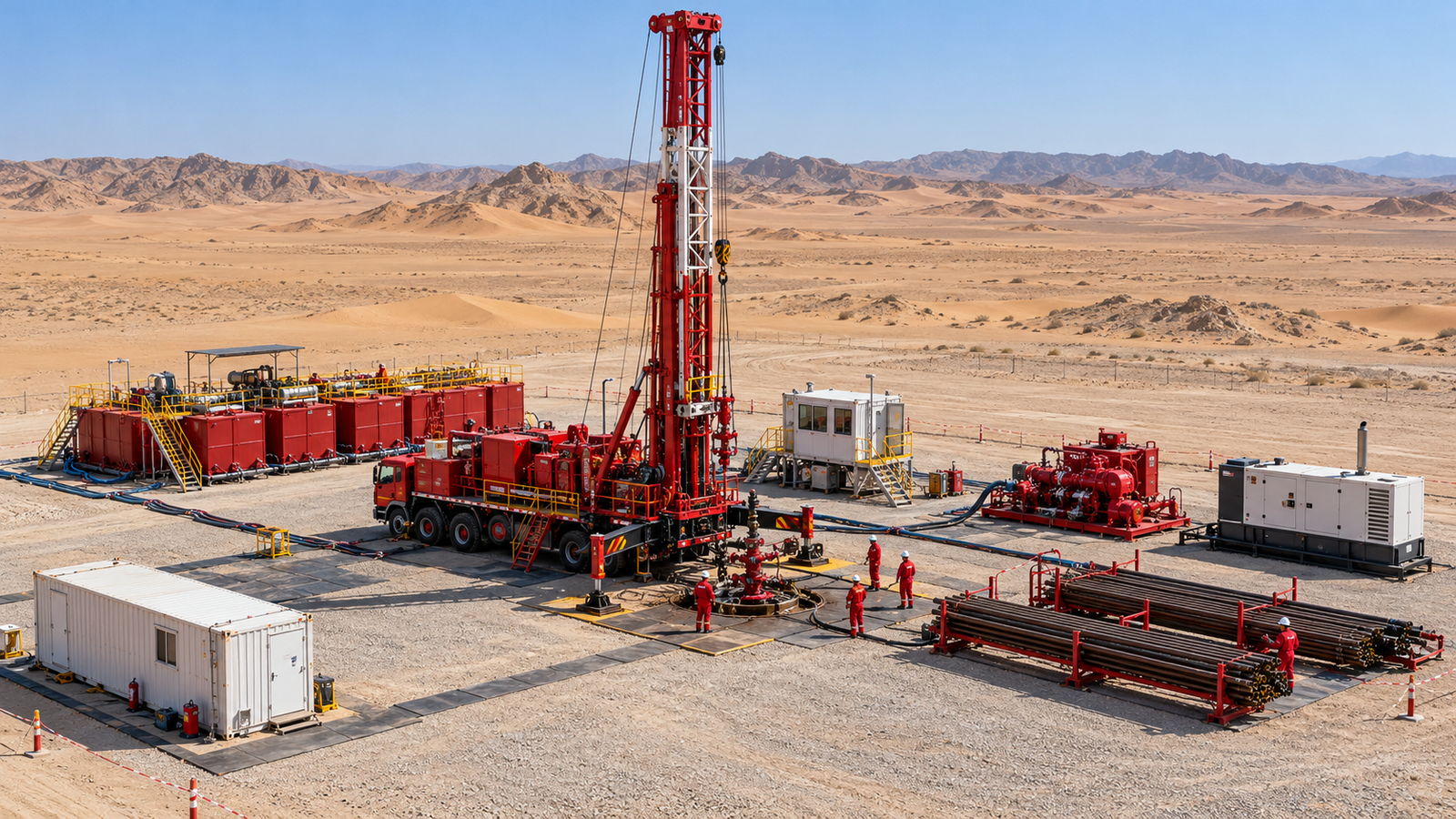
| Package group | Typical scope for discussion | Selection basis |
|---|---|---|
| Base rig | Carrier-mounted rig, mast, substructure, drawworks, traveling system and controls | Well program and calculated loads |
| Carrier | Oilfield chassis, tires, steering, braking, recovery and road equipment | Mounted mass, terrain and route limits |
| Desert preparation | Cooling, air filtration, sealing, fuel treatment and operator protection | Temperature, dust, fuel and duty cycle |
| Work floor and handling | Work platform, pipe racks, catwalk and handling aids | Tubular program and site layout |
| Well control | BOP stack, control unit, manifolds and related connections | Approved well-control program and applicable requirements |
| Circulation and solids control | Pumps, tanks and solid-control equipment | Fluid system, flow rate and separation objectives |
| Utilities and support | Generator, air system, lighting, tools, spares and service consumables | Site infrastructure and maintenance capability |
Emergency power, automatic pipe handling, hydraulic catwalks and other auxiliary systems should be treated as condition-based options unless they are included in the agreed base scope.
New, Refurbished or Used Equipment
New equipment supports project-specific configuration and component selection. Refurbished or used equipment can suit budget-sensitive or shorter-lead-time requirements when the asset identity, condition and proposed overhaul scope are documented.
For refurbished or used workover equipment, the buyer should request serial-number records where available, inspection results, load-bearing and safety-critical component assessment, engine and transmission condition, remaining-life review and a written scope of replaced or repaired items. Compliance with the target well program and desert duty must be reconfirmed after refurbishment.
Desert Workover Rig Selection Table
| Confirmed operating basis | Initial model direction | Chassis reference | What must be confirmed next |
|---|---|---|---|
| 2-7/8 in EUE tubing; calculated requirement within 1,000 kN rated hook load | XJ550 | 10×8 or 10×10 | String load, overpull, route, terrain and desert package |
| Requirement above the XJ550 range but within 1,200 kN rated hook load | XJ650 | 12×8 | Tubular basis, mast load, dimensions and route limits |
| Heavier 3-1/2 in drill-pipe program near the source-listed 6,500 m basis | XJ750 | 14×8 | Maximum load case, power demand, transport and support plan |
| High-capacity 3-1/2 in drill-pipe program near the source-listed 7,500 m basis | XJ1000 | 14×10 | Load case, axle distribution, route access, cooling and maintenance |
| Frequent loose sand or weak ground | Chassis-led review across suitable rig classes | Confirmed after vehicle and site study | Soil, gradients, tire strategy, recovery and road-travel ratio |
Why Work with Hubei Link
Hubei Link Petroleum Equipment Co., Ltd. covers the main equipment groups involved in a workover package: truck-mounted workover rigs, oilfield chassis, solid-control systems, workover auxiliary equipment and new, refurbished or used equipment options.
This integrated scope helps buyers review the rig, chassis, solids-control system and auxiliary equipment as one coordinated package instead of sourcing each subsystem separately.
The configuration discussion can address:
- selection among XJ550, XJ650, XJ750 and XJ1000;
- chassis and transport compatibility;
- desert cooling, dust, fuel and maintenance requirements;
- required equipment versus optional equipment; and
- new, refurbished or used procurement routes.
The technical proposal should identify the confirmed basis, included scope, optional items and points requiring customer approval before manufacture or refurbishment.
Frequently Asked Questions
Which workover rig is best for a Middle East desert oilfield?
There is no universal best model. The appropriate rig is selected from the well program, tubular data, calculated hook load, mast and drawworks requirements, transport route, terrain, temperature, dust, fuel quality and local maintenance capability.
How do I choose between XJ550, XJ650, XJ750 and XJ1000?
First compare the calculated load case with the correct load rating, then check the source-listed tubular basis, mast, traveling system, drawworks and power arrangement. XJ550 and XJ650 references are tubing-based; XJ750 and XJ1000 references use 3-1/2 in drill pipe.
Is a 10×10 chassis always better than a 10×8 chassis in sand?
No. A 10×10 configuration may support a higher-traction objective, but tire selection, axle load, ground pressure, total mass, steering, recovery, road travel and maintenance must also be reviewed.
What adaptations are needed for high-temperature desert operation?
The engineering review normally covers cooling, filtration, electrical sealing, fluids, hoses, seals, batteries and operator protection. The exact package depends on the confirmed maximum temperature, duty cycle and dust conditions.
Why does local fuel quality affect the rig configuration?
Water, contamination and sulfur content can influence fuel treatment, filtration and engine selection. Fuel data should be provided before the power package is finalized.
What transport information should the buyer provide?
Provide the road type, bridge and axle-load limits, maximum transport dimensions, gradients, turning restrictions, gate sizes and the proportion of off-road travel. This information helps determine whether the proposed complete vehicle can reach the wellsite legally and safely.
Can refurbished or used workover equipment be configured for desert service?
Yes, subject to inspection and engineering confirmation. The refurbishment scope should address structural and safety-critical condition, powertrain status, controls, cooling, filtration, seals, fluids and compatibility with the target well program.
What information is needed for an initial recommendation?
Send the well depth, tubing or drill-pipe size, operating country, expected hook load if available, terrain and road condition, and your preference for new, refurbished or used equipment.
Request an Initial Configuration Recommendation
For a first review, send Hubei Link Petroleum Equipment Co., Ltd. these six items:
- Well depth
- Tubing or drill-pipe size
- Operating country and region
- Expected hook load, if available
- Terrain and road condition
- New, refurbished or used equipment preference
This information is enough to begin a model and chassis discussion. The final configuration will be confirmed against the detailed well program and operating conditions.
Optional Detailed Engineering Data
- Tubular grade, connection, unit weight and string length
- Tool string, expected overpull and load allowances
- Maximum and minimum temperature, altitude and dust severity
- Fuel specification and local maintenance capability
- Road, bridge, axle-load and transport-dimension limits
- Mast, work floor, well-control and pipe-handling requirements
- Circulation, solids-control and auxiliary-equipment scope
- Budget range and target delivery schedule