
Technical review draft — Needs Verification.
The supplied XJ550 specification lists a nominal workover depth of 7,000 m with 2-7/8-inch EUE tubing, a 1,000 kN rated hook load, a 1,350 kN mast static load and a 34 m mast clear height. Installed power is recorded as 550 HP / 540 HP, with 10×8 / 10×10 carrier alternatives. These figures describe the source specification; they do not confirm the configuration offered for a particular order or its suitability for a particular well.
For procurement, the useful question is how these ratings relate to the well program, lifting requirements, powertrain, site conditions and acceptance documents. This guide explains those relationships and identifies what still needs confirmation before equipment selection.
What are the core XJ550 specifications?
The core parameters below should be read together with their rating labels and source conditions. The supplied sheet contains power and carrier alternatives, so a quotation should identify the selected configuration rather than repeat every option as if it were included.
| Parameter | Value recorded in the supplied sheet | What the buyer should establish |
|---|---|---|
| Nominal workover depth | 7,000 m with 2-7/8-inch EUE tubing | Whether the tubular schedule and well program match the rating conditions |
| Rated hook load | 1,000 kN | Required lifting loads and the applicable operating load chart |
| Mast static load | 1,350 kN | The rating definition and allowable structural load combinations |
| Installed power | 550 HP / 540 HP | Selected engine, rating basis and power delivery arrangement |
| Carrier drive configuration | 10×8 / 10×10 | Selected axle layout; a conflicting carrier description remains unresolved |
| Mast clear height | 34 m | Compatibility with the intended tubular handling arrangement |
| Tubing-racking capacity, expressed as total tubing length | 6,200 m with 2-7/8-inch tubing | Storage and handling arrangements for the planned tubular operation |
The figures have been checked against the supplied files. A signed, configuration-specific specification and the relevant engineering documents are still required for final selection.
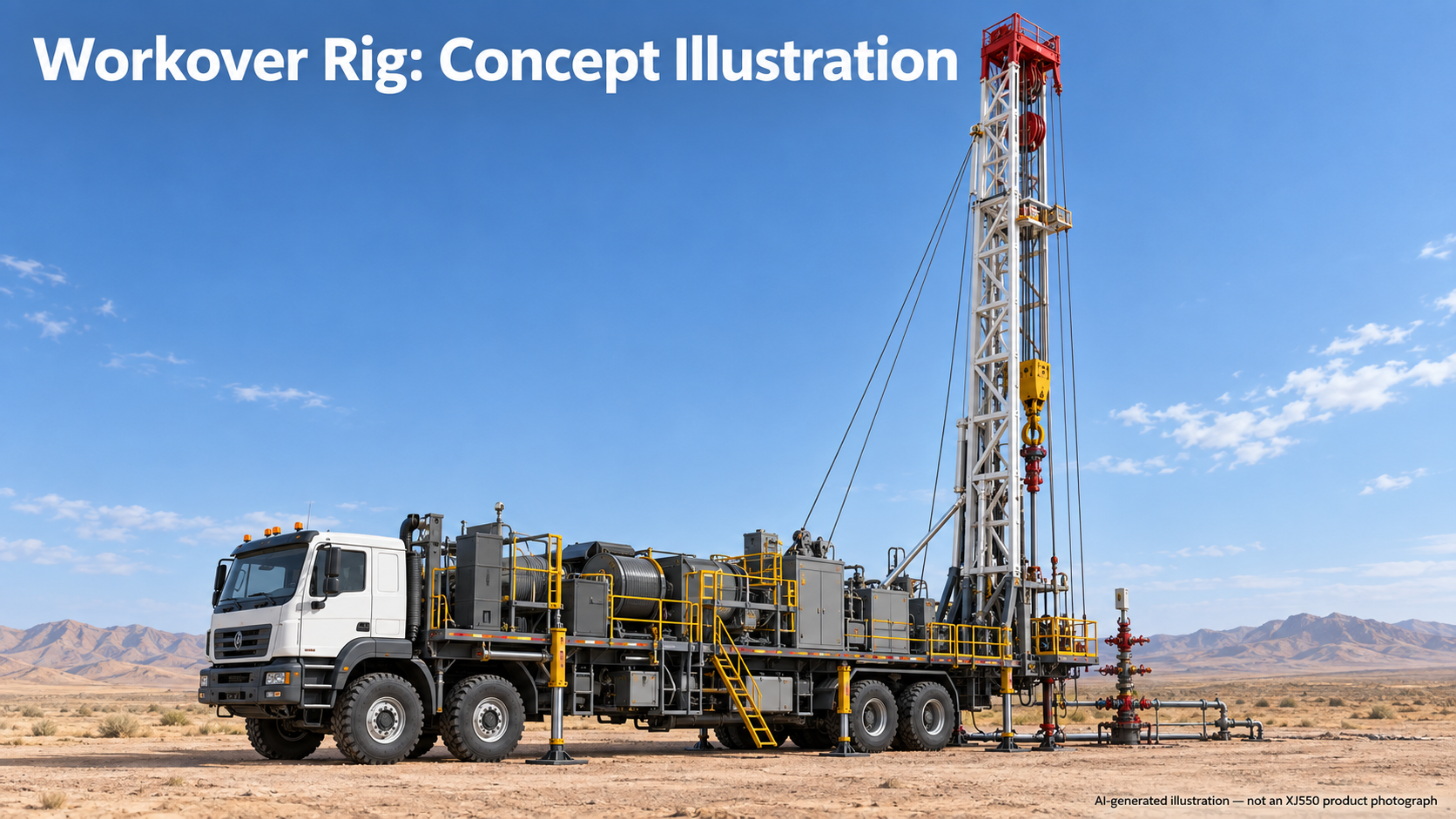
What does the nominal workover depth mean for a buyer?
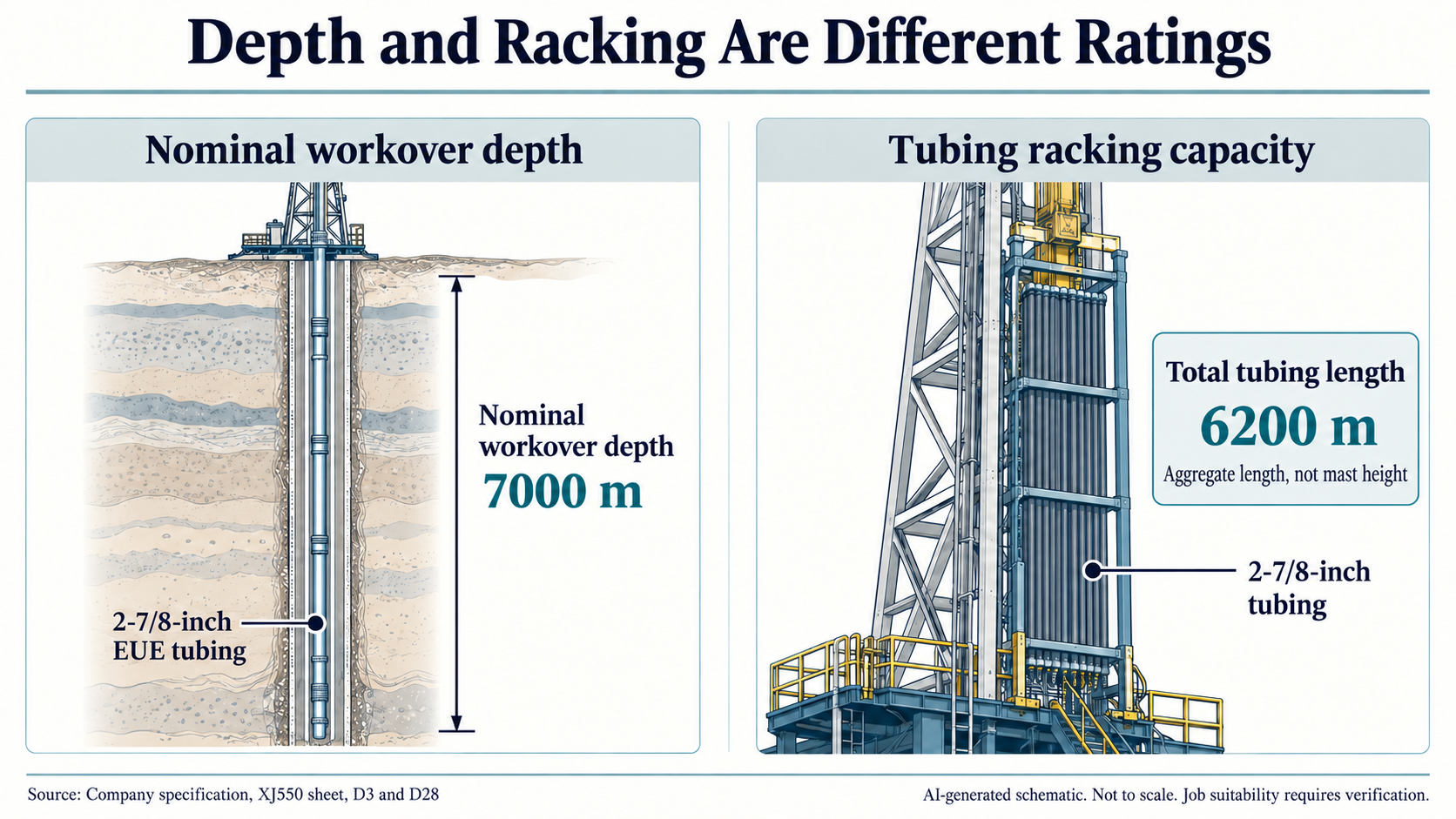
The XJ550 source records a nominal workover depth of 7,000 m with 2-7/8-inch EUE tubing. The tubing condition is part of the specification and should remain attached to the depth figure in a technical comparison. The source does not establish the same nominal depth for every tubular size or well condition.
Start the evaluation with the actual well program: tubular dimensions and weights, planned intervention, expected lifting loads and relevant operating conditions. Ask the supplier to explain the basis of the nominal rating and show how the offered configuration is evaluated against that program.
A depth figure also does not describe the entire tubing-handling arrangement. The sheet separately records 6,200 m of tubing-racking capacity with 2-7/8-inch tubing. This is total tubing length that can be racked under the stated specification, not rack height or mast height. The 34 m mast clear-height figure is a separate dimension.
The procurement implication is to check working depth, lifting requirement and tubing storage separately. Do not infer that a nominal depth rating confirms sufficient racking capacity for the complete operation without reviewing the intended handling sequence.
How do rated hook load and mast static load differ?
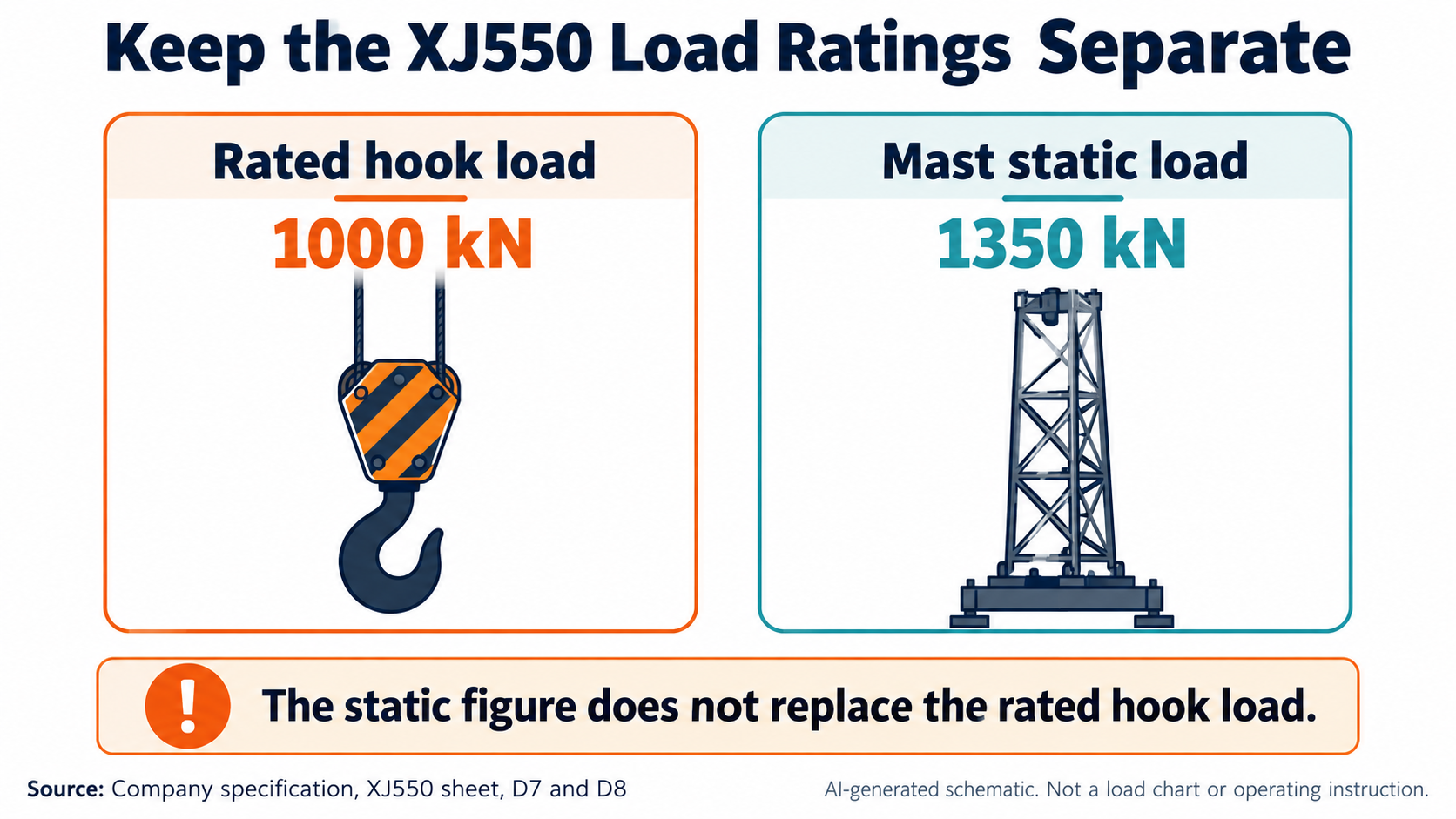
The supplied sheet identifies 1,000 kN as rated hook load and 1,350 kN as mast static load. They are separately labeled ratings. The larger mast figure must not be substituted for the rated hook load or treated as an additional operating allowance.
SLB describes hook load as the force acting at the hook; string weight, buoyancy and wellbore friction are among the factors affecting it. This explains why a lifting evaluation needs more than a depth figure. See the SLB hook-load definition.
For the XJ550, ask for the applicable load chart and the definitions behind the two source ratings. The supplied values alone do not establish allowable combinations of hook load, tubing setback, wind and other structural loads.
The carrier sheet also uses a 1,350 kN maximum static hook-load label. Its terminology should be reconciled with the rig sheet's mast-static-load label rather than assumed to describe the same engineering limit. Request the manufacturer-approved rating definitions and relevant drawings.
What should buyers confirm about the power system?
The XJ550 sheet lists installed-power alternatives of 550 HP / 540 HP. The carrier document separately lists WP13.550E62 / CAT C15 540HP engine options and Allison M5620AR / Kaixing BY603 transmission options. These entries do not, by themselves, confirm the engine and transmission pairing for an offered XJ550.
Request a configuration schedule identifying the engine model, stated power rating, transmission model and the power delivery arrangement to the workover equipment. Where the application requires it, obtain the relevant OEM operating limits and supporting documentation for the selected components.
| Power-system question | Document or detail to request |
|---|---|
| Which engine is included? | Exact model and configuration-specific specification |
| What does the quoted power rating represent? | Rating basis, operating conditions and any stated limitations |
| Which transmission is paired with that engine? | Signed engine/transmission configuration schedule |
| How is power delivered to the workover equipment? | Relevant driveline or power take-off arrangement |
| Are site conditions within the selected components' limits? | Applicable OEM limits and supplied cooling/filtration package |
These are confirmation requests, not claims that a particular power take-off, climate package or component pairing is already included. A model name in an options list is insufficient evidence for those conclusions.
Which carrier configuration is actually being offered?
The rig and carrier sheets list 10×8 / 10×10 alternatives, but the carrier document also states that all axles are driven. That general description cannot be applied to both alternatives without clarification. The offered drive arrangement remains Needs Verification.
Conflict detected:
| Parameter | Listed drive options | General axle description | Required confirmation |
|---|---|---|---|
| Carrier drive arrangement | Drive options: 10×10/10×8 | General axle description: all axles are drive axles | Configuration-specific axle layout identifying the actual driven and steering axles |
Do not resolve the conflict by selecting whichever description appears more suitable for the project. Request the signed axle arrangement, then evaluate road access, site mobility and transport requirements against that configuration.
For transport planning, also request the complete rig's dimensions, axle loads and travel condition. Carrier information should not automatically be treated as the dimensions or loading of the fully assembled workover unit.
Do these specifications establish suitability for a particular project?
No. The specification provides equipment ratings and configuration alternatives. Project suitability requires those records to be checked against the well program, actual tubulars, required loads, operating environment and project requirements. The supplied files do not establish universal suitability for Iraq, the Middle East, desert conditions or cold-climate operations.
For a hot or dusty site, request the documented ambient operating limits and details of the supplied cooling and filtration package. For cold conditions, request the relevant starting, fluid, material and operating limitations. These requests should be answered for the selected configuration, not by a general statement about the XJ550 model family.
Compliance requires the same distinction. API identifies Specification 4F as covering drilling and well servicing structures. The official API 4F information is relevant to structural-documentation discussions. Referencing that standard does not prove that this XJ550 configuration is certified or compliant. Obtain the product-specific evidence required by the project before making such a claim.
What should be included in the buyer checklist?
Use the checklist to connect each selection question to evidence. A commercial offer is easier to compare when the configuration, rating conditions, technical exclusions and required documents are recorded explicitly.
| Buyer question | What to check | Evidence to request |
|---|---|---|
| Does the depth rating match the planned operation? | Tubular specification, well program and rating conditions | Signed specification and application review |
| Is the lifting capacity adequate? | Required operating loads and load combinations | Configuration-specific load chart and rating definitions |
| Is the mast arrangement appropriate? | Clear height, handling arrangement and structural requirements | Mast drawing and relevant design documents |
| Can the planned tubing be handled and stored? | Total racking length and operating sequence | Tubing-handling and setback arrangement |
| Which power system is included? | Engine, transmission and power delivery arrangement | Signed configuration schedule and relevant OEM documents |
| Which carrier is supplied? | Driven/steering axles and transport condition | Approved axle layout resolving the source conflict |
| Are site conditions within equipment limits? | Temperature, dust, filtration, cooling and access | Configuration-specific limits and package details |
| What compliance evidence is required? | Applicable standards, editions and project acceptance criteria | Product-specific certificates or conformity/design records, as applicable |
| What is included commercially? | Delivery scope, commissioning, spare parts and support obligations | Written scope, exclusions, schedule and service terms |
The commercial items are questions to settle in the offer. This article does not establish a delivery commitment, spare-parts stock level or after-sales capability.

The illustrations in this guide are AI-generated explanatory schematics. Their geometry is illustrative and not to scale; they are not product photographs, approved drawings or load charts. The tubing illustration does not verify an EUE connection design.
Frequently Asked Questions
What is the nominal workover depth of the XJ550?
The supplied sheet records 7,000 m with 2-7/8-inch EUE tubing. Keep that tubing condition with the depth figure. Actual suitability requires review of the well program, tubular schedule, loads and operating conditions.
Can the mast static load be used as the rated hook load?
No. The source separately lists 1,000 kN rated hook load and 1,350 kN mast static load. Obtain the applicable load chart and rating definitions; do not use the larger mast figure as an operating hook-load allowance.
Is the installed power 550 HP or 540 HP?
Both appear as alternatives in the supplied rig sheet. The exact engine and its stated rating should be confirmed in the signed configuration schedule. The article does not select one as the universal XJ550 specification.
Which engine and transmission are included?
The carrier sheet lists WP13.550E62 / CAT C15 540HP engines and Allison M5620AR / Kaixing BY603 transmissions as options. The pairing and applicability to the offered rig remain unconfirmed.
Does the 6,200 m racking figure describe mast height?
No. It is the recorded total tubing-racking length with 2-7/8-inch tubing. Mast clear height is separately listed as 34 m. These parameters answer different handling and layout questions.
Does an API standard reference prove product certification?
No. A standard reference identifies a technical requirement or discussion topic. Product certification or compliance requires evidence for the actual equipment and the relevant scope; neither is established by citing API 4F alone.
Where can buyers review the XJ550 product information?
Use the XJ550 workover rig product page to review the product information alongside this guide. For selection, obtain a signed configuration schedule and resolve the load-definition, axle-layout and application questions identified above.
Source notes
Product parameters are based on the company-supplied XJ550 workover-rig and carrier specifications. Technical definitions and standard context are linked to the official sources in the relevant sections.